Last week marked the close of the first week of the second negotiated rulemaking to implement the higher education provisions of the One Big Beautiful Bill Act, Public Law 119-21 (OB3). Convened by the Department of Education (the Department), the AHEAD negotiated rulemaking committee began its work by tackling one of the most closely watched elements of OB3: changes to the Federal Pell Grant program, including the creation of a new Workforce Pell Grant for short-term programs. The rulemaking reached consensus with the regulatory process to implement the new Workforce Pell Grants, as directed by Congress, to take effect on July 1, 2026.
For this rulemaking, the Department deliberately narrowed the committee’s focus, separating what were originally two large issue areas, Workforce Pell and Accountability, into distinct, week-long discussions. Week one focused on the regulatory framework needed to support the new Pell Grant opportunity for 8-to 15-week workforce-oriented programs. As with all negotiated rulemakings, the goal was to reach consensus on regulatory language. Consensus means that no committee member dissented from the final draft proposal for regulatory language at the conclusion of the meetings. When consensus is achieved, that language, subject to technical adjustments, forms the basis of the Department’s proposed regulations released for public comment. The AHEAD committee was successful in reaching consensus during week one, largely on the implementation structure for Workforce Pell.
This work builds on momentum from the previous RISE negotiated rulemaking, which concluded in early November and also achieved consensus. The agreed-upon RISE language is now posted on the Department’s website, providing the higher education community an early look at what is expected to appear in the forthcoming Notice of Proposed Rulemaking (NPRM).
In this post, we will address three key areas that affect the digital learning community:
Provide a brief recap of why these regulations are being developed and how the negotiated rulemaking process is structured.
Share the major elements from week one of the AHEAD committee, which reached consensus on the regulatory framework for implementing Workforce Pell Grants, with states and Governors at the center of implementation.
Recommend next steps for reviewing available materials and preparing to engage in the public comment process.
Recap: Why These Regulations Are Being Developed, and How the Rulemaking Is Structured
The Department convened two negotiated rulemaking committees to implement the higher education provisions of the One Big Beautiful Bill Act (OB3). OB3 made significant statutory changes that require regulatory direction before institutions, states, and students can fully understand how the new policies will operate in practice.
Most notably, OB3 created a new Federal Pell Grant eligibility pathway, commonly referred to as Workforce Pell, for short-term programs designed to lead to in-demand occupations, as determined by states. This marks a substantial expansion of the Pell Grant program beyond its traditional focus on longer-term academic undergraduate programs. In addition, OB3 established new accountability standards intended to apply across all institutional sectors, reflecting a statutory emphasis on holding all institutions accountable to students for program-level student success and economic return on investment.
To conduct these statutory directives, the Department established two negotiated rulemaking committees:
The second committee, the AHEAD Committee, was charged with the more complex tasks of implementing Pell Grant changes, including Workforce Pell, and developing institutional accountability regulations.
Departing from past practice, the Department adopted a compressed rulemaking schedule, allotting only two weeks total to each committee. For AHEAD, Pell Grants and Accountability are being addressed in separate discussions and consensus votes, requiring members to deliberate and decide on each issue within a single week, with no time to consult constituencies between sessions.
Under negotiated rulemaking requirements, consensus language approved by the committees, subject only to technical edits, will form the proposed regulations, which will be issued as a Notice of Proposed Rulemaking (NPRM) and opened for public comment before finalization.
Elements of Workforce Pell Grant Implementation
Week one of the AHEAD negotiated rulemaking focused on the Federal Pell Grant program, setting the foundation for how the statute’s workforce-focused eligibility expansion will operate in practice. Pell Grants are designed to provide need-based grant assistance to low-income students to help cover the cost of undergraduate education and training.
As directed by statute, the committee’s week one negotiations centered on defining student eligibility for Pell Grants and implementing the new authority to expand Pell eligibility to shorter-term workforce programs. While this expansion creates a significant new access opportunity for students seeking in-demand credentials leading to employment, it also introduces new regulatory responsibilities for institutions and states, particularly around program approval, oversight, and the conditions under which programs may retain eligibility as determined by the Secretary of Education.
Key Elements of Eligible Workforce Programs
Offered for programs that are eight weeks to less than fifteen weeks of instruction and 150-599 clock hours.
Aligns education with high skill, high wage, in-demand employment as determined by each state’s Governor.
Meets the hiring requirements of potential employers for intended employment for programs.
Arrangements by the institution with an ineligible provider must not exceed 25% of the educational program.
Must achieve a 70% completion rate within 150% of normal time to completion.
Must achieve a 70% job placement based upon state data analysis.
Not offered for courses offered by correspondence or part of a study abroad program.
Must comply with annual value-added earnings requirements.
Governor and State Responsibilities
Governors will play a central role in implementing Workforce Pell Grants. In consultation with a state board, Governors must establish a state-level process to review institutional requests and determine whether a program meets applicable statutory and regulatory requirements. Through this process, the Governor assesses whether proposed programs align with the state’s identified in-demand occupations and meet required standards related to program quality, duration, and workforce relevance. State approval is required both for initial eligibility and for programs to maintain eligibility. Upon a Governor’s approval, the Secretary may certify the program as eligible to award Workforce Pell.
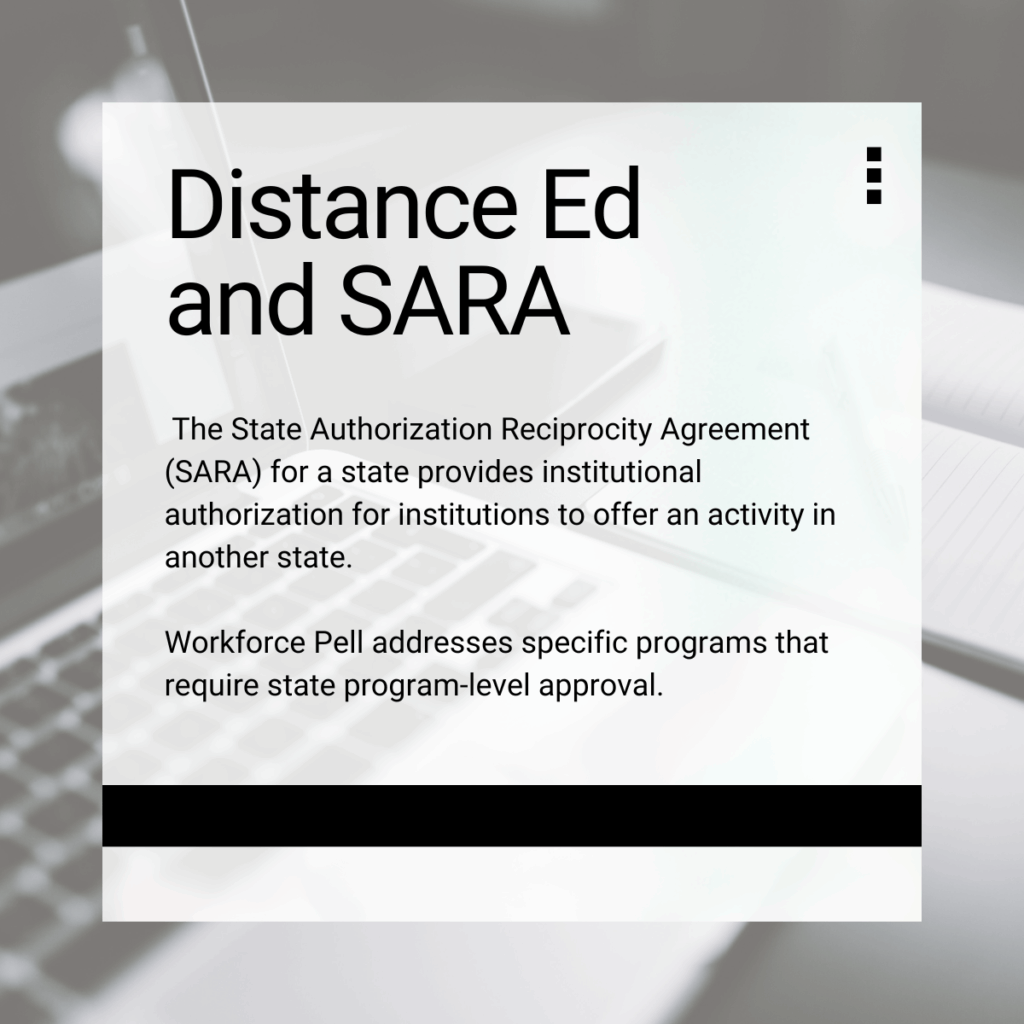
For interstate distance education, the consensus language allows Governors of two states to enter into bilateral agreements permitting students in one state to enroll in eligible programs located in another state. The Department emphasized Congress’s intent that states play a direct role in setting conditions and collecting data necessary to implement Workforce Pell. While reciprocity through the State Authorization Reciprocity Agreements (SARA) was raised by negotiators, the distinction was discussed that while SARA may provide participating institutions the institutional state approval to offer an activity in another state, Workforce Pell addresses specific programs that require state program approval to be eligible workforce programs.
Overall, the statute reflects Congress’s intent for states, through their Governors, to serve as a key gatekeeper for Workforce Pell. This state review function reinforces OB3’s reliance on state labor market expertise and establishes a formal accountability checkpoint before federal Pell funds can be used for short-term workforce programs.
The practical elements for data collection and maintaining eligibility will continue to be assessed and shared in future WCET Frontiers posts.
Next Steps to Review Materials and Prepare for Engagement
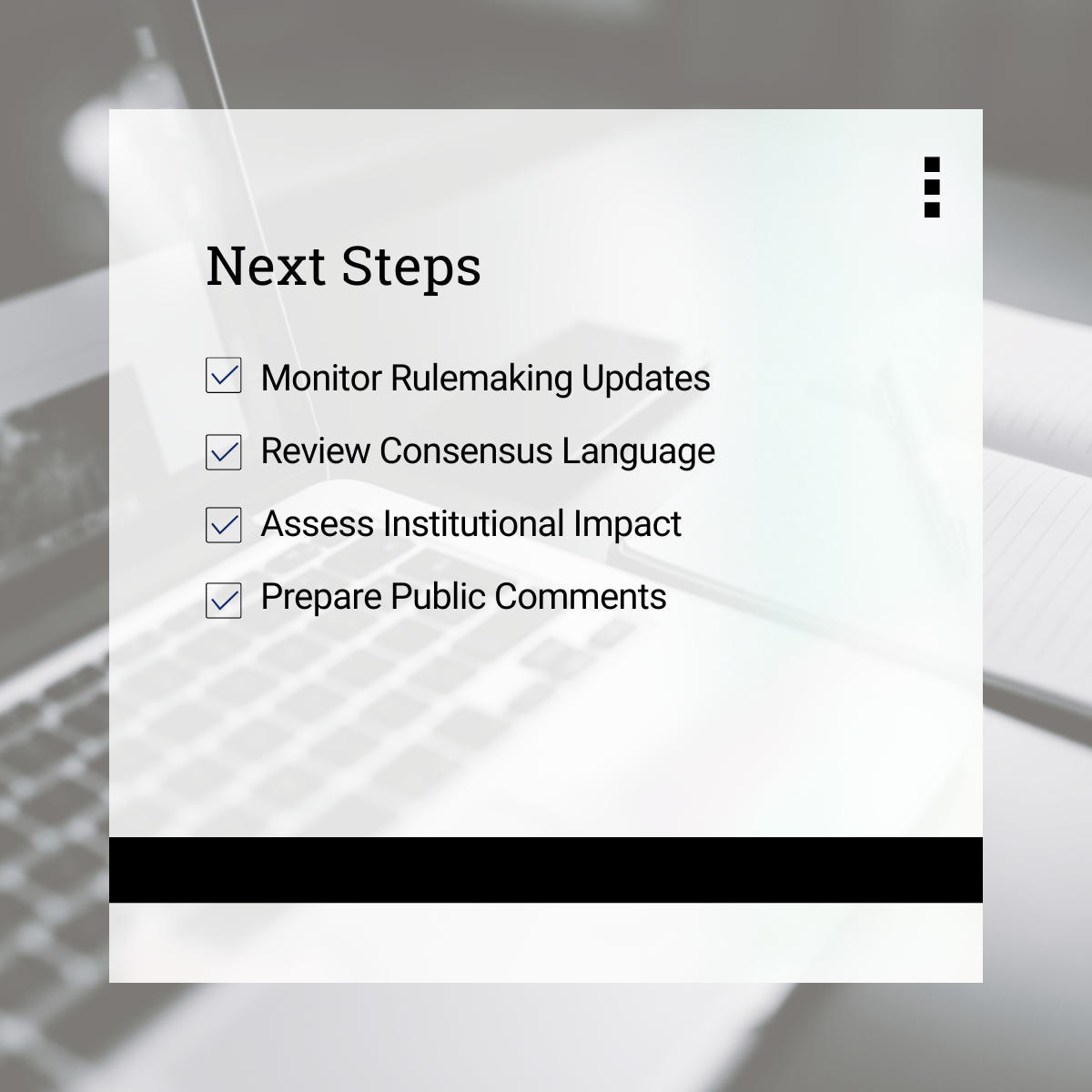
As shared in our previous rulemaking post, we urge our community to monitor rulemaking resources and consider the potential regulatory impact.
It is critical for the digital learning community to pay close attention to the Department of Education rulemaking to assess whether and how consensus draft regulations apply to distance learning, and to anticipate operational, compliance, and financial impacts. Early awareness allows institutions to evaluate implementation timelines, identify necessary system or policy changes, and estimate costs or resource demands. Equally important is the opportunity to review consensus regulatory language during negotiated rulemaking, to prepare informed public comments, seeking clarification, flagging practical implementation challenges or conflicts with existing requirements, and offering constructive suggestions or support, before the rules are finalized.
Stay Tuned
The Department will convene the second half of the AHEAD Committee on January 5-9, 2026. Registration to stream the meetings will be available soon on the Department’s rulemaking webpage. In addition, the Department is anticipated to release proposed regulations from the RISE Committee early in the new year and has signaled further rulemakings in 2026 focused on accreditation. Taken together, 2026 is shaping up to be another busy year for higher education policy. WCET and SAN will continue to keep you informed and provide implementation-focused analysis of developments affecting the digital learning community. Stay tuned!
Policy analysis for judicial opinions, statutes, regulations, and guidance related to postsecondary digital education,
Compliance training for institutions to meet distance education-related requirements to provide student consumer protections,
State and Federal Compliance considerations for out-of-state activity compliance for postsecondary institutions (including for military students).
Bio
Cheryl joined WCET in August 2015 as the director of the State Authorization Network. She currently serves as the senior director, policy innovations. She directs the overall activities of WCET’s State Authorization Network (SAN), including coordination of staff addressing interstate policy and compliance and other ancillary compliance issues. As senior director, Cheryl also serves the overall WCET membership in addressing emerging and special regulatory issues related to digital learning in postsecondary education. She brings extensive experience in education and compliance to the WCET team and is a contributing author for State Authorization of Colleges and Universities, a guidebook for understanding the legal basis for State and Federal compliance for activities of postsecondary institutions.
Cheryl holds a Juris Doctorate from the University of Richmond, a master’s degree in criminal justice from Bowling Green State University, and a bachelor’s degree in political science from James Madison University. She is the mother of four kids, all of whom have been instrumental in helping her develop new interests in theatre, hockey, and figure skating. Outside of work, Cheryl enjoys spending time with her family and is an avid fan of movies and TV shows written by Aaron Sorkin.
We use cookies to ensure that we give you the best experience on our website. If you continue to use this site we will assume that you are happy with it.