And The Magic Eight Ball Says...
Published by: WCET | 1/9/2026
Tags: Artificial Intelligence, Digital Learning, Distance Education, Managing Digital Learning, Online Learning, Student Success, WCET, Workforce/Employment
Published by: WCET | 1/9/2026
Tags: Artificial Intelligence, Digital Learning, Distance Education, Managing Digital Learning, Online Learning, Student Success, WCET, Workforce/Employment

This month marks my one-year anniversary as WCET’s executive director. I frequently get asked how my first year has gone. My reply is always that it’s been an interesting time to step into leadership at an organization that lives at the intersection of higher education policy and technology.
Between my one-year anniversary and the predictable deluge of 2025 retrospectives, I find myself reflecting on what we’ve weathered over the past year and what digital learning leaders need to be ready for in 2026.
We have weathered tremendous political, social, and economic shifts in 2025, and digital learning leaders have been squarely in the middle of them. As I look back, five shifts stand out as especially important for digital learning leaders.
On Inauguration Day, President Trump began signing a veritable cornucopia of executive orders, many of which have focused on higher education. These executive orders have ranged from anti-DEI measures to accreditation reforms to the dismantling of the Department of Education. No corner of higher education has gone unaffected. In addition to executive orders, this Administration has also filed an unprecedented number of lawsuits against institutions, including powerhouses like Columbia, Harvard, and UCLA.
For digital learning leaders, this has equated to uncertainty. Will current regulations change? What are the federal priorities? How can you plan multiyear strategies when the ground keeps shifting under your feet?
It has been a year of economic belt-tightening for higher education. Although there have been fewer closures and mergers than in 2024, the year has been littered with programmatic cuts and closures at a wide variety of institutions, ranging from Ivy League institutions to regional publics to community colleges.
Digital learning leaders are impacted as they are asked to do more with less while simultaneously managing hiring freezes, delayed projects, and an overwhelmed technical infrastructure.

2025 also marked the beginning of a demographic decline in the number of high school graduates. In addition to the decline in high school graduates, we have seen a drop in international students amid political uncertainty and deportations.
These shifting student demographics will undoubtedly have a significant impact on higher education for decades to come.
For digital learning leaders, this shift underscores how our student population will increasingly expect on-demand learning options as our new learners struggle with family, work, and school.
With the Department of Justice’s Title II regulations slated to take effect this April, accessibility work took on new urgency in 2025. Institutions began expanding their understanding of accessibility beyond PDF remediation to include areas like mobile experience and descriptive audio. This allows for a broader understanding of what constitutes digital access.
Much of the responsibility for digital accessibility has fallen on the shoulders of digital learning leaders who are tapped to help translate regulations into action.
AI was certainly not new in 2025, but last year marked a maturation as institutions moved beyond thinking only about AI’s pedagogical impact to instead explore AI’s impact on operational efficiencies across the institution. Additionally, 2025 brought the rise of agentic AI and new pedagogical challenges, as well as an increase in so-called ghost students driven by AI and a subsequent increase in financial aid fraud.
Digital learning leaders now find themselves juggling AI policy, pedagogy, and risk management with little precedent to draw on.
So, what do we have to look forward to in 2026? I believe 2026 will bring both new challenges and opportunities for digital learning and higher education.
As institutions begin to fully feel the impact of Gainful Employment and Financial Value Transparency regulations, the relationship between higher education and the workforce will become even more important. Workforce Pell is slated to go into effect in 2026. And if further evidence of the importance of this relationship is necessary, the number of credentials shows that Americans are seeking post-high school credentials, whether they be degrees, certificates, or certifications, in record numbers.
In late 2025, the three major credit agencies, Fitch, Moody, and S&P, all issued negative outlooks for higher education in 2026. Given the economic cuts that many institutions made in 2025, there is little fat left to trim. And whereas states and the federal government provided institutions with an infusion of cash to help weather the financial crisis of 2020, there is no evidence that such cash is in the offing this time around. In fact, we are seeing the federal government reduce funding to higher education, and many states may have to shift higher education funding to cover federal gaps for Medicaid.
There are now 43.1 million American adults with some college and no credential, a record high. As institutions grapple with the downturn in high school graduates, these non-completers will play an increasingly important role in filling empty seats.
Institutions that have long relied on high school graduates will need to rethink program offerings and services to appeal to post-traditional learners who have come to expect on-demand services and information, forcing institutions to develop new programs and pathways to degrees and credentials.

During the fall of 2025, WCET undertook a survey of institutions to determine how they were responding to the new Title II regulations. In that survey, 95% of institutions reported that they have taken action towards coming into compliance. However, the lack of staff, money, and the need to convince all staff that accessibility is everyone’s responsibility remain significant challenges (for more on this survey, look for the release of our survey report later this month).
In an effort to help institutions meet the April 2026 deadline, WCET is partnering with 1EdTech to offer Planning to Deliver: A 1EdTech and WCET Accessibility Workshop Series. This workshop series will not only provide institutions with important information on the Title II regulations and practical compliance strategies, but it will also provide institutional teams with personalized coaching. More information on the workshop series can be found on our event webpages.
As higher education places more focus on post-traditional learners to offset the loss of traditional-age learners, digital learning will become increasingly important. These learners, used to being able to access anything at any time of the day or night, will expect that same level of access and service from higher education. And online learning will also allow institutions to expand their potential student pool to a national audience. Additionally, the best online learning practices will play a greater role in developing excellence regardless of modality as more and more faculty deploy digital learning tools.
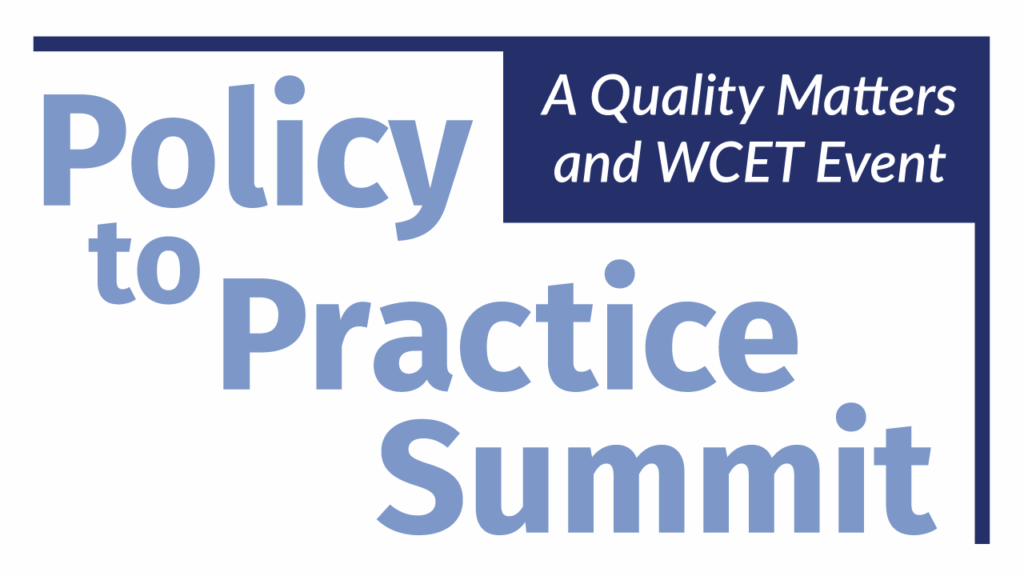
Towards that end, WCET is pleased to be partnering with Quality Matters to offer a February 26th “Policy to Practice Summit” virtually. Visit our website for more information on this exciting event, which is open to WCET or QM members.
As we move into 2026, WCET will continue to monitor the policy landscape and provide timely updates and analysis, whether through the Frontiers Blog, our monthly member-only policy update newsletter, and the WCET SAN Policy Tracker. We’ll also continue to provide information on the new Department of Justice Title II regulations, as well as timely AI analysis and information, including a revision of our popular AI Policy and Practice Framework. And, of course, the WCET community is here for you, whether that be your peers via wcetMIX, Closer Conversations, an affinity group, or the WCET staff.
Last year, when I became Executive Director, my predecessor, Russ Poulin, gifted me a Magic 8 Ball that sits on the conference table in my Boulder office. It serves as a reminder to me that, although we can make some educated predictions, no one can say with certainty what 2026 holds. Regardless, though, you don’t have to face that future by yourself; WCET is here for you.
This post was written by Van Davis, Executive Director of WCET
At WCET, we believe in being transparent in how we use AI. Perplexity and Grammarly were used to review this blog post and offer suggestions for improvement.