What Week Two of AHEAD Rulemaking on Accountability Measures Means for Digital Learning
Published by: WCET | 1/21/2026
Tags: AHEAD, Digital Learning, Distance Education, Online Learning, Regulation, U.S. Department Of Education
Published by: WCET | 1/21/2026
Tags: AHEAD, Digital Learning, Distance Education, Online Learning, Regulation, U.S. Department Of Education
The new year began with the second and final week of The U.S. Department of Education’s (The Department) negotiated rulemaking for the Accountability in Higher Education and Access through Demand-driven Workforce Pell (AHEAD) Committee. Week two focused on program accountability measures that will address consequences for failing programs. Processes were developed to address a program’s failure to meet accountability metrics that will determine continued eligibility for Direct Loan participation as charged by the higher education provisions of the One Big Beautiful Bill Act Public Law 119-21 (OB3).
During this second session, the committee reached consensus on a single, unified program-accountability test that will apply to all programs across every institutional sector. The consensus language also includes amendments to the currently effective Gainful Employment/Financial Value Transparency (GE/FVT) regulations to align (“harmonize”) them with this new accountability framework. As with week one of the rulemaking committee, OB3 specifically directs that the regulations become effective July 1, 2026, despite the fact that under the general statutorily directed master calendar structure regulations not final by November 1, 2025, would normally not go into effect until July 1, 2027.
The Department structured the AHEAD Committee’s work into two focused segments:
A consensus vote was taken at the end of each week for that week’s proposed draft regulations. In both weeks, the committee came to consensus. Consensus means that no committee member dissented from the final draft proposal for regulatory language. When consensus is achieved, that language, subject to technical adjustments, forms the Department’s proposed regulations released for public comment.
It is important to recognize that both the AHEAD Committee and the RISE Committee were convened to address issues explicitly directed by OB3. This means that the rulemaking committee must follow the framework as stated in statute and operate within a defined framework, unlike prior negotiated rulemakings that often modified regulations in ways that varied by administration. Regulations rooted in specific statutory instructions are generally more stable over time and are unlikely to change unless Congress amends the underlying statute.
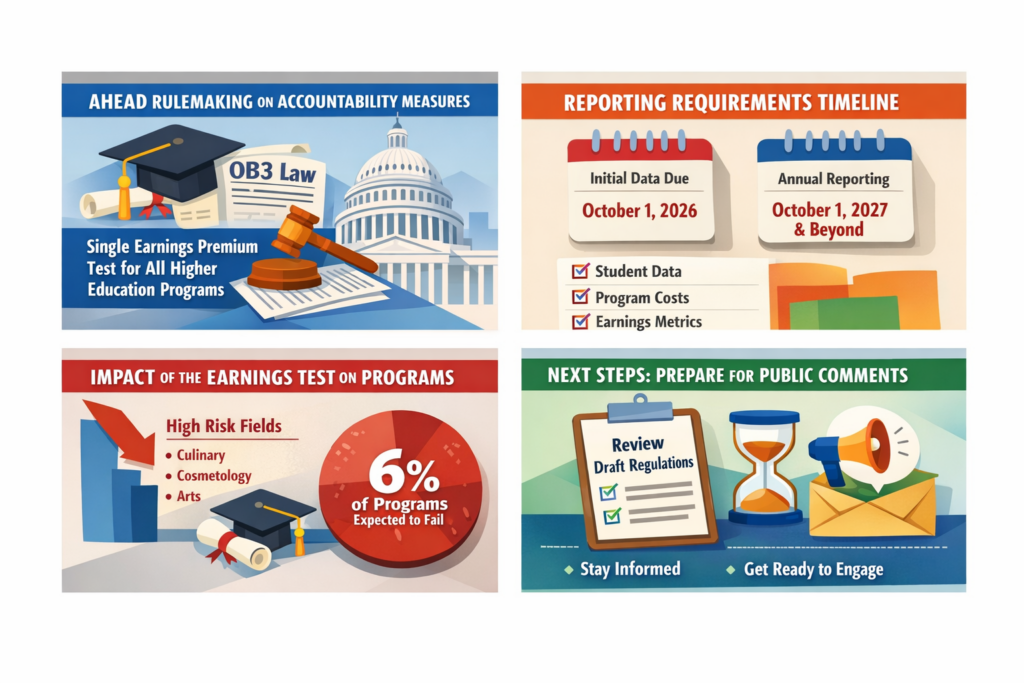
Week two covered complex and nuanced material. In this post, we will outline four essential elements for the digital learning community by addressing three relevant areas of the draft regulations that affect the digital learning community and next steps institutions should take to prepare for implementation and engage in the rulemaking process.
The rulemaking committee reached consensus to implement a “single earnings-premium accountability test” for ALL postsecondary programs to determine eligibility for Title IV federal aid. This accountability test applies to every program regardless of modality (on-campus, hybrid, or distance education) and across all institutional sectors. During rulemaking discussions, the Department emphasized that OB3 requires an earnings-based accountability system that is not sector-specific, unlike prior Gainful Employment (GE) regulations.
The single earnings-premium accountability test implements the statutory “Do-No-Harm” earnings accountability standard from OB3. The public policy reasoning for the accountability standard is to ensure that students are not left in a worse financial position in the years following completion of their postsecondary program. The test compares the program’s median annual earnings four years after completion of the program to a defined earnings benchmark. The program fails if the institution’s completers’ median earnings fall below the benchmark. The benchmark is defined as follows:
Failure to meet the benchmark for two of three consecutive award years will cause the program to lose eligibility for Direct Loan participation for two years and the program is then designated as a “low-earning outcome program.”
Some negotiators raised concerns about whether such programs should also remain Pell-eligible, noting that students could be spending limited Pell Grant funds on programs that consistently fail to produce value. To address the issue, consensus language includes an additional test that measures whether a failing program accounts for either half of an institution’s students enrolled or more than half of federal student aid funds disbursed to the program. Programs meeting either of those thresholds would not only lose eligibility for Direct Loan participation but also all Title IV federal student aid including Pell Grants.
For the digital learning community, institutions must be aware that hybrid and distance education must meet the same earnings-premium metrics. Institutions may want to consider how to mitigate accountability risks through effective instructional design, robust online student support, and continuous improvement strategies for digital learning programs.
Institutions will first be required to report program-level and student-level data to the Department by October 1, 2026, covering the two most recently completed award years. Beginning in 2027, institutions must submit this information annually by October 1. This data supports the Department’s calculation of median earnings and the earnings-premium metric for each program under the new accountability framework.
Required reported data include:
The Department anticipates publishing the initial earnings-premium results by July 1, 2027, enabling institutions and the public to review program-level earnings outcomes ahead of the first potential accountability determinations.
During the rulemaking meetings, the Department shared extensive data analysis illustrating the potential impact of the new accountability matrix. These data reports are available on the Department’s AHEAD Committee rulemaking webpage. Aaron Lacey of Thompson Coburn LLP, the primary negotiator representing Private Non-Profit Institutions, recently presented a summary of the Department’s Program Performance Data 2026, which estimate:
WCET and SAN continue to advocate that the digital learning community monitor rulemaking resources and consider the potential regulatory impact. The three OB3 rulemaking committees have now all concluded in consensus. This means that in advance of the release of the proposed regulations, we know the language of these packages, and we can discuss issues with our colleagues and anticipate participation in the public comment opportunities.
Consider the following anticipated timeline for the release of the proposed regulation packages. The Department has stated that the RISE Committee proposed regulations will be released soon with the AHEAD Week One Pell proposed regulations following a few weeks after the RISE package and then followed a few weeks later by the release of the AHEAD Week Two Accountability proposed regulations.
The release of these packages of proposed regulations in a short span of time could make one’s head spin! It means that the public comment periods could overlap. Therefore, it is essential to review the consensus language straight away.
RISE Committee Consensus Language:
AHEAD Committee Week 1 – Workforce Pell Consensus Language
AHEAD Committee Week 2 – Accountability Measures Consensus Language
Although the rulemaking did not specifically target digital learning, the implications of the accountability measures will significantly influence how distance education programs are evaluated, measured, and administered moving forward. Institutions with substantial online or hybrid offerings will need to incorporate these new accountability requirements into their compliance efforts, program evaluation processes, and strategic planning. As the rulemaking advances to the proposed regulations stage, WCET and SAN will continue monitoring developments and informing our community to support effective institutional planning and preparedness. Meanwhile, federal policy updates and curated resources can be found on the WCET and SAN Policy Tracker!