How to Not Be an Ostrich in the Age of AI
Published by: WCET | 2/26/2026
Tags: Artificial Intelligence, Managing Digital Learning, Online Learning, Technology
Published by: WCET | 2/26/2026
Tags: Artificial Intelligence, Managing Digital Learning, Online Learning, Technology

I’m currently testing out Copilot for WICHE as we work to refine our AI strategy and implementation. This morning, when I opened a new Word document to write this blog post, I was greeted with a helpful window prompting me to tell it what I wanted to write. Three minutes and one refinement to the prompt later, I had a page and a half draft of a blog post on the promises and problems of technology in higher education. Was it the best blog post in the world? No, but it made a few compelling arguments and would have been easy to revise had I wanted to use it. The experience left me disconcerted, though. I’ve known since the release of ChatGPT how easy it is to use one of these LLMs to create written documents, but there is something about opening a Word document and being immediately confronted with a box essentially asking you what you want it to do that feels different. It makes it oh so easy to rely on the AI to do the hard work of thinking and creating.
I’m familiar, of course, with research on cognitive offloading and AI. In a study published last year, Michael Gerlich found that “while AI tools offer undeniable benefits in terms of efficiency and accessibility, they may inadvertently diminish users’ engagement in deep, reflective thinking processes.” The potential for users to over rely on AI tools and to uncritically accept results increases the younger the user. And, in addition to Gerlich’s work, there is the work of Kosmyna et. al., who found that subjects who wrote an essay without the assistance of an LLM and then transitioned to using an LLM had higher brain activity than those subjects who started out by writing an essay with the assistance of an LLM. In fact, Kosmyna et. al. found that a certain amount of “cognitive debt” was created in the group that used the LLM, thus hypothesizing that brain activity may actually decrease while using an LLM and make it more difficult to re-engage later.
I’ve never been an apologist for technology (although I have been accused of being one on more than one occasion). I know there are real perils in how technological tools are developed and deployed in higher education, especially with AI. In addition to cognitive offloading, there are real dangers posed by agentic AI. Simply put, agentic AI is an AI system that has some degree of agency. Rather than just answering questions or responding to a prompt, agentic AI takes actions on its own to pursue a specified goal.
So why do I bring up agentic AI? Agentic AI offers extraordinary opportunities for higher education at the same time that it poses a significant threat. Autonomous AI agents trained on institutional data have the ability to answer student questions 24/7, proactively reach out to potential students and current students to foster engagement, provide faculty with detailed and actionable learner analytics, and provide administrators with real-time analysis of complex institutional data. But at the same time, agentic AI also poses a new and unique threat to higher education, especially digital learning. Institutions are already grappling with AI agents that can complete distance education courses without any student input or effort. And many institutions are now challenged by AI agents that are enrolling with the sole purpose of becoming eligible to receive federal and state financial aid.
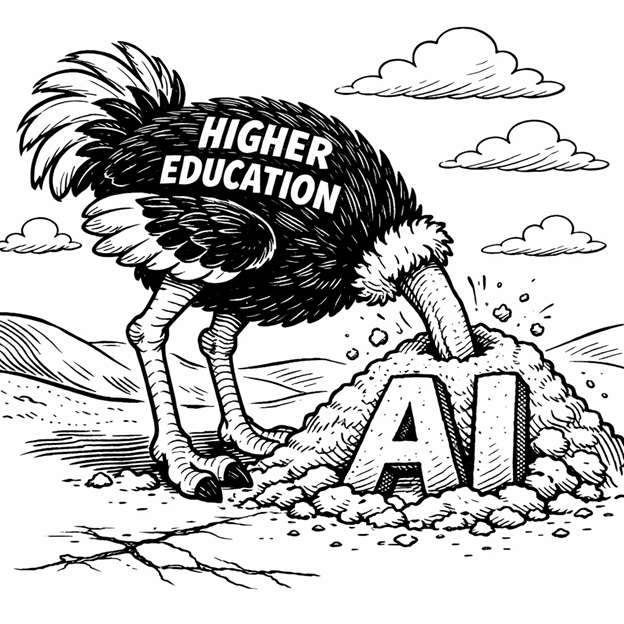
Does this mean that we have the luxury to ignore AI or try to eradicate it from our classrooms and campuses? No. Technology in general, and AI in particular, offers incredible opportunities for our faculty, staff, and students. We have a responsibility to make sure that our students understand the ethical use of AI tools if we want them to be successful citizens. And AI can afford our institutions with assistance in better serving students, whether that be through AI agents assisting with student outreach, agentic tutoring bots, or tools that allow faculty and staff to focus on what humans do best—build relationships with students. But we also cannot bury our heads in the sand like the proverbial ostrich. Now is the time for us to be clear-eyed about the promises and perils of technology so we can help our students navigate our increasingly complex, technological world.
I don’t know how I feel about a world where it is so easy to offload intellectual and creative work to AI. Even as I type this blog post, there’s an icon in the margin of my Word document beckoning me to click on it so it can help me finish this post. I’m not prepared to eschew AI, nor am I prepared to relinquish my intellectual and creative tasks. I still believe that part of learning involves grappling with information and ideas, and it’s our job to help our students learn how to do just that. I’m not sure I know where the balance is, but I do know that these are the hard sorts of questions that WCET is interested in exploring. And I look forward to exploring them with you, our members.
Author: Van Davis, Executive Director, WCET