More Than Disclosures: Understanding the State Oversight Layer in Nursing Program Compliance
Published by: WCET | 3/19/2026
Tags: Distance Education, Professional Licensure, Regulation, State Authorization
Published by: WCET | 3/19/2026
Tags: Distance Education, Professional Licensure, Regulation, State Authorization
If a nursing program’s curriculum satisfies a state’s educational requirements for an individual to qualify for licensure in that profession, it may seem reasonable to assume the institution can enroll students located in that state or place them in required clinical experiences there. After all, if the program prepares students to become licensed in that state, the path to operating there might appear straightforward.
In practice, it is often more complicated. Across the country, nursing programs may face additional state program-level requirements addressing whether an institution is approved to operate the program itself or place students in clinical experiences within the state. These requirements are frequently administered by state boards of nursing and may apply even to campus-based programs placing students across state lines. They operate separately from institutional authorization processes administered by state higher education agencies, including authorization obtained through the State Authorization Reciprocity Agreement (SARA), and are not covered by participation in that agreement.
In a previous blog post, Certifying Compliance in an Uncertain Landscape: Survey Findings on the Impact of Professional Licensure Requirements, we highlighted findings from a recent State Authorization Network (SAN) report showing that the workload associated with managing professional licensure compliance has increased significantly, in part due to evolving federal disclosure and certification requirements.
Today’s blog post explores another dimension of that work: the state-level requirements that address whether nursing programs can enroll students or place students in clinical settings across state lines. These requirements further illustrate the complexity, breadth, and variability of institutional obligations associated with professional licensure programs.
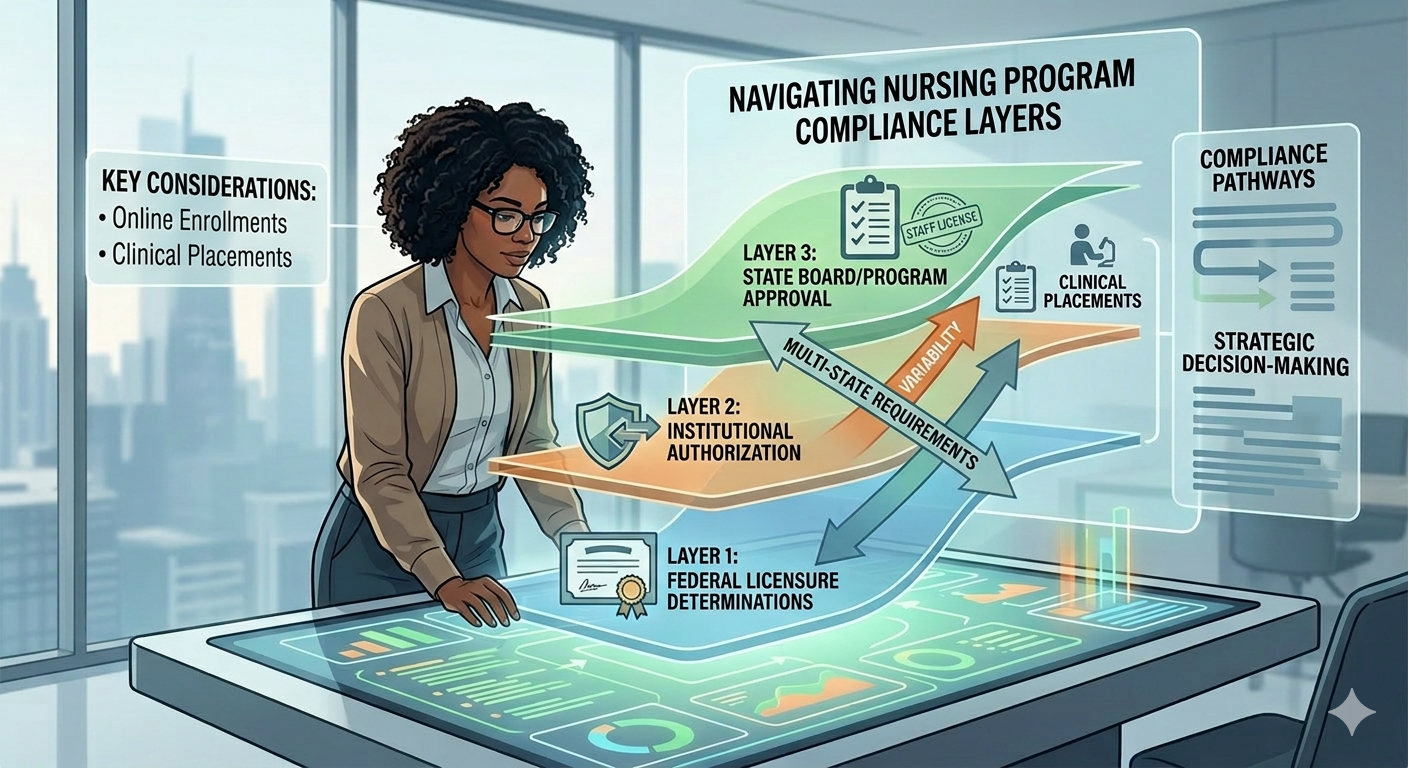
Institutions must often navigate several regulatory frameworks at once: federal rules governing licensure disclosures and determinations, state authorization requirements for institutions, and separate program oversight by state licensing boards. While these frameworks frequently intersect in practice, they were developed for different regulatory purposes and do not always align.
When required, institutions must obtain authorization from the state higher education agency in every state where students are located. This can be done directly or through participation in the State Authorization Reciprocity Agreement (SARA).
Separate from institutional authorization, some states may impose requirements or expectations on programs wanting to operate in the state. These may include:
These requirements can apply to online programs enrolling out-of-state students, campus-based programs placing students in clinicals across state lines, and faculty teaching online.
Federal regulations require institutions to determine whether a program’s curriculum meets a state’s educational requirements for licensure and to provide required disclosures to students.
These requirements address transparency regarding program alignment with state educational requirements. They do not replace or eliminate separate institutional obligations to state licensing boards. Accordingly, an institution may accurately determine that its curriculum satisfies a state’s educational requirements for licensure and yet still needs approval from that state’s board of nursing before enrolling students located there or placing students in clinical experiences in the state.
Key Takeaway:
Satisfying a state’s educational requirements for licensure does not automatically grant an institutional program permission to enroll students or place them in clinical experiences. Institutions should give careful attention to where students and faculty are located and ensure review of state program approval/compliance requirements.
To help institutions navigate the complexities of state program requirements, SAN recently developed the Nursing Program State-Specific Requirements Chart (available to SAN members). The chart focuses on state board authority that may affect program approval or oversight, clinical or practicum activity, faculty or instructor qualifications, and other state-specific conditions or limitations, particularly for out-of-state and online programs. While the chart is designed as a practical research tool, the process of developing it also reveals why identifying and interpreting these requirements can be far more complicated than it appears.
Developing the chart required reviewing statutes, regulations, guidance, and frequently asked questions from state nursing boards across the country. What quickly became clear is that identifying the regulatory language is only the first step; understanding how those rules apply to out-of-state or online programs often requires careful analysis, and, in some cases, direct engagement with state regulators.
A key insight from developing the chart was that state nursing program requirements, and the extent to which they apply to out-of-state institutions, exist along a spectrum of clarity. For compliance professionals, this understanding can help prioritize review, identify potential risks, and guide operational decisions for their multi-state programs.
Some state regulations explicitly address program approval requirements, clinical placement approvals or notifications, and faculty licensure requirements for out-of-state programs. In some cases, a state may not require a formal application, but it clearly communicates that out-of-state programs must meet the same standards as in-state programs. For example, statutes or regulations may clearly state that:
For institutions, the compliance pathway is clearer, and while clarity does not necessarily mean simplicity, it does allow institutions to make structured compliance decisions with greater confidence.
Other state regulations are more ambiguous when it comes to applicability of regulations to out-of-state programs. Regulations may reference “nursing education programs” without specifying whether they apply to:
Vague or broad language increases the complexity and overall risk of compliance analysis. Institutions must spend more time reviewing statutes, rules, and guidance to determine applicability and to feel confident in their interpretation, whether through internal discussion, benchmarking with peer institutions, or direct engagement with regulators.
Proper understanding of the applicability of the state program requirements is critical to ensure programs can enroll students, place them in clinical experiences, and meet faculty licensure obligations without violating state regulations.
Understanding where state requirements are explicit and where they are ambiguous, and the expectations these distinctions create for out-of-state programs and faculty, is critical not just for compliance, but for operational planning. These regulatory nuances can influence everyday decisions across multi-state programs, including:
The Nursing Program State-Specific Requirements Chart (login required) helps SAN members navigate this complexity by highlighting patterns, potential regulatory triggers, and areas requiring interpretation. While it is not a substitute for institutional review or engagement with regulators, it provides a structured starting point for state-level compliance research and operational planning.
By mapping these distinctions, institutions can make informed decisions, allocate compliance resources more effectively, and support program accessibility and student mobility, all while maintaining alignment with state and federal regulatory expectations.
SAN encourages members to review the Nursing Program State-Specific Requirements Chart and share any clarifications or updates to strengthen future iterations. Collaborative input helps ensure the nursing chart and future charts reflect evolving state requirements and institutional experiences.
In addition to member-only resources, SAN offers a variety of tools to support professional licensure compliance, available to both members and non-members. The Getting Started page on the SAN website provides access to resources including the Professional Licensure Requirements Handbook (2nd edition), which offers guidance for developing a robust licensure compliance strategy.
Professional licensure compliance is complex, and collective insight remains one of the most effective tools institutions have. By leveraging available resources and sharing knowledge, institutions can better manage risk, support student mobility, and ensure programs meet both state and federal obligations. If you have questions, we encourage you to reach out at san-info@wiche.edu.