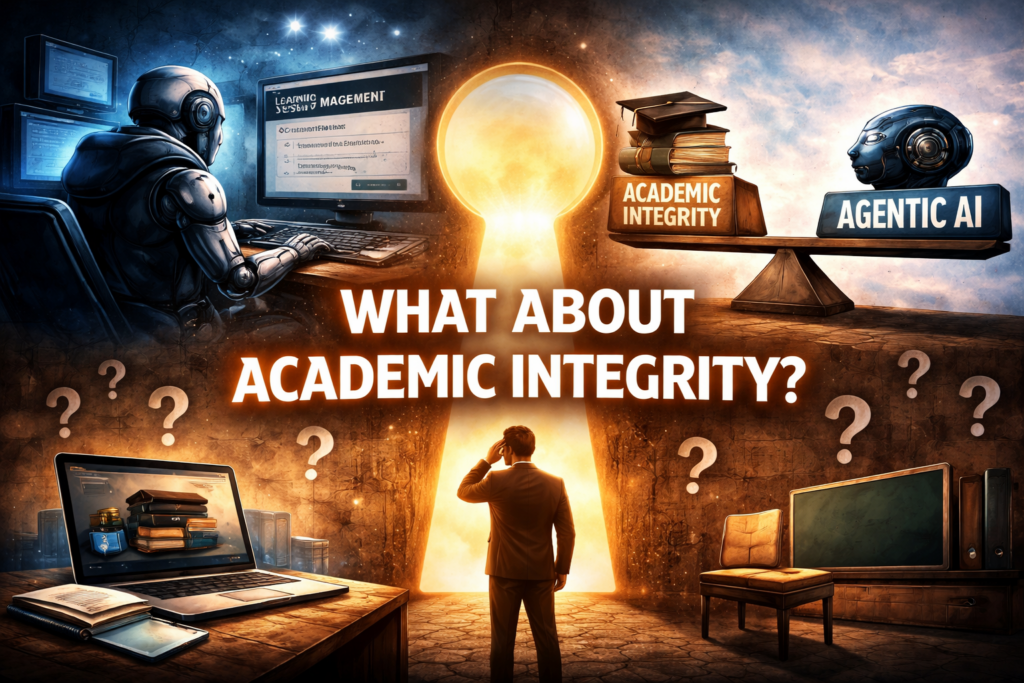
Recently, I was participating in a nationwide AI workgroup where someone suggested that the very phrase academic integrity is problematic. The argument was that it implies students lack integrity or are cheating when they use AI. In that same conversation, there was an undercurrent that anyone focused on integrity concerns might be a Luddite, someone unwilling to embrace the positive transformation AI will bring to higher education.
I admit I felt a bit triggered, as my son would say.
The irony is that I am generally an optimist about technology. Throughout my career, I have championed the use of digital tools to remove barriers, increase efficiency, and expand opportunity. Online education itself is proof of that, and artificial intelligence is no exception. AI is transformative, excitingly disruptive, and institutions should absolutely be exploring how it fits into our strategic planning and the core of what we do in higher education.
You can probably hear the “but” coming.
It is the thing we often avoid acknowledging when we talk about all the promise AI holds: What about academic integrity?
For the past two years, much of the discussion has focused on students copying assignment prompts into tools like ChatGPT, adjusting the prompt, and submitting the generated response into the learning management system. That concern is real, but the situation is already more complex than that with Agentic AI.
The Arrival of Agentic AI
At one college, we were reviewing Learning Management System (LMS) data when something caught our attention. Students were completing fifty-item short-answer and short-essay exams in about three seconds.
Note that is not long enough to copy a question into an AI tool, generate a response, and paste it back into the LMS.
Unlike earlier tools that simply generated text when prompted, emerging AI agents can carry out multi-step tasks with minimal human intervention. Tools such as Perplexity’s Comet or Einstein are designed to plan, search, synthesize, and act across systems.
In practical terms, an AI agent could be instructed to do something like this:
Log into my LMS using these credentials. Review my four course shells for assignments, exams, and discussion posts due soon. Complete the work according to the instructions and rubrics. Submit the responses.
An agent can search for, plan, revise, and complete tasks across multiple sources in seconds, mostly autonomously. That means AI systems can already perform many of the activities we once relied upon as evidence of learning.
For example, agents can easily:
Summarize a video lecture or assigned reading and incorporate outside research.
Write discussion posts that acknowledge peers and respond to course material.
Produce comparative analyses or research syntheses while citing readings.
Solve complex math problems while showing steps and work.
Complete “authentic assessments” that ask students to connect course concepts to real-world issues or personal experiences.
Present “humanized” assignments that access personal anecdotes and background.
Respond to reflective prompts asking students to analyze the societal impact of AI.
None of this means learning has become impossible to measure. It does mean that many of the artifacts we traditionally used as proof of learning no longer reliably demonstrate that learning occurred.
Image generated by ChatGPT
The Worries We Whisper Privately
Since I have already delivered the difficult news, I will now voice the concerns that many of us quietly share but do not always say out loud. If institutions fail to grapple seriously with the implications of agentic AI, several things could happen:
Online education, which many of us have worked tirelessly to establish as equivalent to on campus instruction, could lose credibility.
Fully asynchronous online courses, which provide the greatest flexibility for students, could come under intense scrutiny or even be phased out.
In community college systems like mine, transfer institutions might stop articulating fully online courses because they no longer trust that those courses prepare students for upper division work.
The learning management system, which has become central to teaching and student support, could become less relevant as instruction shifts back toward in-person formats.
We might see a return to blue books, timed in-class exams, and other analog forms of assessment.
And in the meantime, we could graduate a generation of students who are deeply dependent on AI to do the thinking and producing that education is meant to develop.
None of these scenarios are wildly paranoid. What worries me most is that if they unfold, they could drive higher education backward.
What is Really at Stake
Online education has expanded access to students who were historically excluded from traditional campus environments.
Students with disabilities who cannot easily navigate physical campuses.
Parents balancing coursework with childcare.
Working students with complex schedules.
Student athletes who travel extensively.
Military students, caregivers, and many others whose lives do not fit neatly into traditional class schedules.
Fully online and asynchronous courses have made education possible for these students.
My concern is that fear and uncertainty around AI could push institutions to retreat toward older instructional models that were designed for a far narrower population of learners.
If that happens, we will not simply be solving an academic integrity problem. We will be narrowing access to higher education itself.
Moving from Fear to Strategy
If the future described above feels unsettling, you’re not alone. In the past year, I have spoken to countless colleagues, faculty, and administrators alike, who have voiced their concerns. The roadmap I’ll describe in this section is no silver bullet. Rather, they are a collection of tools and strategies that can be leveraged to grapple with these topics:
Engage Humans: Meet with your faculty and community members to learn about their concerns. Hold open forums, online discussions and create communities of practice. Honestly and transparently acknowledge these frustrations and realities.
Rethink assessment and learning: Colleagues tend to immediately jump to the need to totally change our online teaching and assessment practices as the go-to solution for the problem of Agentic AI. Across the sector, faculty are in fact already successfully experimenting with different approaches, including incorporating more synchronous online engagement, requiring iterative drafts, checkpoints, or oral explanations of reasoning. But a reliance only on faculty to change their teaching is unrealistic and overly simplistic. A shift will require years and will require trust, relationships, investments, mentorship, and intellectual curiosity.
Examine the many layers of Agentic AI: Work with your IT and admissions teams to uncover whether AI Agents are being deployed as bad actors during your application process. Are these agents also enrolling in your courses and drawing financial aid? There are several tools that our system is using with some success for this issue, including N2N’s LightLeap AI tool. Also, look at your SSO and MFA policies, which can provide an additional layer of security.
Engage with your LMS Administrator: The LMS administrator at your institution likely has access to a number of useful analytics that can aid instructors in better understanding their students’ behaviors in online courses. For example, examining click stream data, time taken on assessments, or other student behaviors in the LMS can provide useful insights. Our system is currently engaged with Instructure to explore some of these data points.
Find your technology partners: The CVC oversees our system’s Instructure Canvas contract, and we have been clear as their biggest customer about our expectation that they partner with us to address these concerns. We are also working closely with other cybersecurity and technology providers, as well our procurement teams across the system to understand the intersection of AI across our technology infrastructure.
Check your policies: Do syllabi specifically name Agentic AI? How do faculty communicate their expectations around use of AI and AI agents? Have your institution’s Distance Education, Curriculum and other key committees grappled with the topic? Have you started to revise course outlines of record to consider the use of AI agents?
Invest in professional development: Our system has a number of no-cost professional development opportunities for various employee types, including faculty, staff, and even HR professionals. Some of those opportunities are available through CVC@ONE, including courses and webinars, and others are available through partner organizations like the Digital Center for Innovation, Transformation, and Equity (DCITE).
Find your community: Fortunately, higher education has always been a collaborative ecosystem. Consortia, statewide systems, and national organizations like WCET exist precisely because institutions benefit from sharing ideas and learning from one another. I have personally learned a tremendous amount from our own colleagues in other states and systems navigating the same topics.
The conversation we need to keep having
Agentic AI will continue to evolve rapidly, and new capabilities will appear faster than policy frameworks can keep up. That reality means institutions must stay engaged in ongoing conversations about pedagogy, integrity, and the role of technology in education.
I am fortunate to work with a systemwide leadership team at the California Community College Chancellor’s Office, engaged faculty, and our local Foothill-De Anza Community College District that is very progressive and proactive in terms of its approach toward problem-solving. If we all approach this moment with similar curiosity, collaboration, and a commitment to human-centered learning, higher education can adapt as we have many times before.
Author: Marina Aminy, Ph.D.Executive Director, California Virtual Campus, Associate Vice Chancellor, Foothill-De Anza Community College District
Dr. Marina Aminy is Associate Vice Chancellor at Foothill-De Anza Community College District and Executive Director of the California Virtual Campus (CVC), a statewide initiative serving the California Community Colleges system, which supports 2.2 million students annually across 116 colleges. The CVC expands student access to high quality online courses, digital technologies, course sharing, and an ecosystem of instructional and student services to accelerate completions. She previously served as an administrator and full-time faculty member at both the college and university levels, and has more than 25 years of experience in higher education. Marina holds a Ph.D. from UC Berkeley, and has dedicated her career to advancing student success through equity-minded practices, policy, and innovation in digital learning.
We use cookies to ensure that we give you the best experience on our website. If you continue to use this site we will assume that you are happy with it.