Known and Knowing: The Case for Community in Online Learning
Published by: WCET | 4/2/2026
Tags: Community, Managing Digital Learning, Online Learning, Student Success
Published by: WCET | 4/2/2026
Tags: Community, Managing Digital Learning, Online Learning, Student Success
I came out of a graduate program that focused on research over teaching. I received one day of pedagogical training, which (because, as a historian, I was tapped to teach freshman composition) was half a day more than my peers. During my first few years of teaching, I floundered and struggled to find ways to both connect with students and facilitate their connections with each other. I didn’t understand pedagogy and certainly couldn’t articulate a teaching philosophy. And when I taught my first online course in the early 2000s, the first online course at my institution, I certainly didn’t understand how digital community could be created. But I intuitively knew that at least part of my job was to foster a sense of community in the classroom, and that doing so could be a radical act.
I went searching for examples of what good teaching looked like. My early teaching career was highly influenced by the likes of John Dewey, Paulo Freire, bell hooks, and Parker Palmer.
In To Know as We Are Known: Education as a Spiritual Journey, Palmer posits that “Knowing is a profoundly communal act” that requires learners to be “brought into relationship with the teacher, each other, and with the subject.” In essence, Palmer argues that community is at the heart of education, especially an education that creates an environment where students can do the hard work of true learning. For Palmer, learning requires both students and teachers to be in relationship with each other. One of the roles of the teacher is to create space for students to find connectedness. How does a teacher do that? Palmer argues it is through creating an “air of hospitality,” which means “receiving each other, our struggles, our newborn ideas with openness and care.” In essence, learning involves struggling with ideas, and our students can only do that in a community where they feel a sense of belonging and safety.
But one of online learning’s little secrets is that it is easy for courses, unless carefully and deliberately designed, to default into what Brazilian educator Paulo Freire calls “the banking model of education.” In it, students are seen as containers or receptacles to be “filled” by the teacher. In essence, “Educating thus becomes an act of depositing in which the students are the depositories and the teacher is the depositor…This is the ‘banking’ concept of education, in which the scope of action allowed to the students extends only as far as receiving, filing, and storing the deposits.” Freire argues that such a model does not allow for students to be engaged in discovering true knowledge which relies on the “restless, impatient, continuing, hopeful inquiry human beings pursue in the world, with the world, and with each other.”

What does this mean for online education, and how do we ensure that we are not defaulting to Freire’s banking model? As online educators, we must take the development of community and belonging seriously. Community means something different in online education where we don’t have the luxury of students physically being in the same space at the same time — community is a necessity for successful teaching and learning. We as educators must be much more intentional in our creation of community and opportunities for students to engage in that community.
That’s why WCET is pleased to partner with Alamo Colleges District and Rio Salado College on an Axim Collaborative grant focused on improving the retention of online students by addressing the lack of connection and belonging among fully online learners. Despite being in good academic standing, thousands of students across both institutions don’t persist each year. This partnership aims to change that by creating more human, inclusive virtual spaces where students can build networks, access support, and stay on track to graduate or transfer.
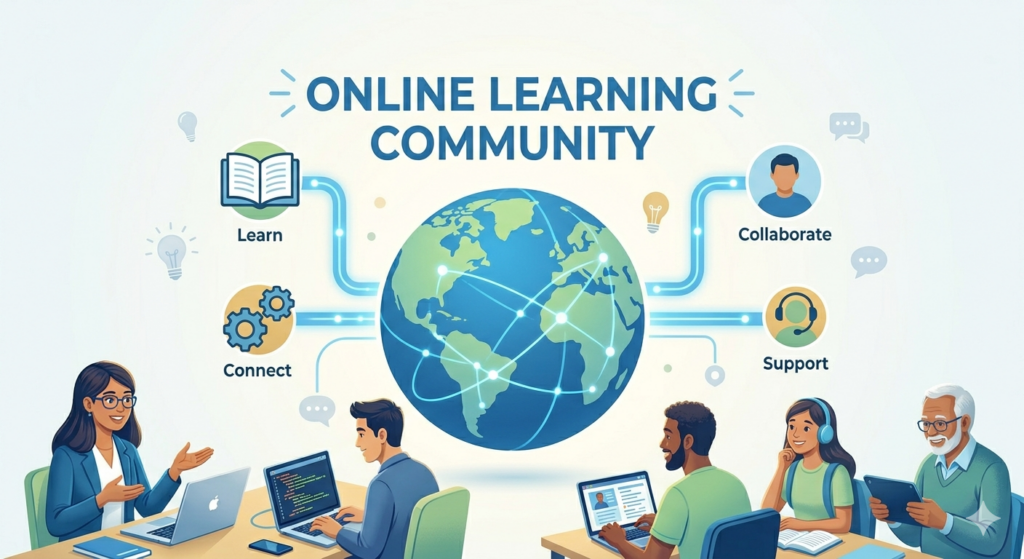
I believe we are at a moment where our digital spaces are polarizing us, where they become instruments of division rather than places of community. Yet our learners need that sense of community and, most importantly, safety and belonging that community can bring. How we show up for our learners and how we create community and opportunities for belonging can resonate far beyond our classes. It can be the creation of space that transforms our learners’ lives as well as the lives of their families. But we can’t just create classes where the only relationship is between the student and the teacher. We have to, in the words of Palmer, create places where “Only in community does the person appear in the first place, and only community can the person continue to become.” We are challenged to move beyond a banking model of education and find ways to leverage digital tools in ways that ensure safety to wrestle with big and difficult truths and create connection.
At WCET, we believe that deliberately designed, high-quality digital learning can change lives. But the design and offering of such courses takes effort. Our mission is to help institutions and educators leverage the best practices and digital tools to effectively teach students and develop that sense of community that is so necessary for learner retention and success. We would love for WCET members to join this conversation about online community and belonging in MIX.
WCET members, join the conversation in MIX and share your good practices for building community and cultivating belonging.
At WCET, we believe in being transparent in our use of artificial intelligence. Google Gemini assisted in research, and Claude Sonnet was used to generate the blog post title.
Author Van Davis, Executive Director, WCET