Building Internal Capacity: How the University of Pittsburgh School of Health and Rehabilitation Sciences Moved Beyond Its Online Program Manager
Published by: WCET | 5/14/2026
Published by: WCET | 5/14/2026
Authored by Rae Mancilla, EdD, Executive Director of University Digital Education; Natalie Baney, MBA, Executive Director of Digital Enrollment; Anthony Delitto, PhD, Associate Provost of Digital Education; and University of Pittsburgh Center for Excellence in Digital Education (Pitt EDGE).
Institutions of higher education have faced mounting fiscal pressures in recent years. The combined impact of enrollment cliffs, shrinking state appropriations, and the looming demographic decline of traditional college-age students have driven institutions to seek new revenue streams, while scrutinizing costs in unprecedented ways (Forrest et al., 2025). For many institutions, scaling online and hybrid programs has become a critical strategy for generating new enrollments and building alternative revenue sources. However, this approach is only viable if institutions can expand their online portfolios without trading one financial risk for another (Nyre, 2025).
For many institutions, partnering with an online program manager (OPM) once seemed like the fastest path to stand up and scale new online initiatives by leveraging their marketing, enrollment, instructional design, and student services capabilities in exchange for a share of tuition revenue; however this model has been on the decline. Since 2024, new OPM partnerships have dropped 42%, with only 81 new partnerships recorded, representing a record low for the industry (Palmer, 2025). In addition, 61% of higher education and online learning leaders anticipate making changes to their OPM agreements in the next one to two years (Collegis Education, 2024).
For many institutions already engaged in an OPM partnership, the steps for transitioning away from a revenue sharing agreement may be unclear. The following case will describe the efforts of an R1 institution to build the internal capacity needed to move from OPM dependency to a fully in-house operation, gradually, transparently, and at a fraction of the cost.
At the University of Pittsburgh (Pitt), the School of Health and Rehabilitation Sciences (SHRS) was an early adopter of an alternative approach to outsourcing online education. In 2018, instead of entering a traditional revenue-sharing agreement with our OPM, we negotiated a fee-for-service contract for four new online and hybrid graduate programs, including our signature Physical Therapy program. Initially, the OPM provided an array of services, including instructional design, marketing and enrollment management, student support, and clinical placements (see Mancilla & Cochenour, 2024). From the outset, we were transparent in our intentions to transition away from OPM services by building internal capacity over the course of the contract, gradually absorbing one functional area at a time.
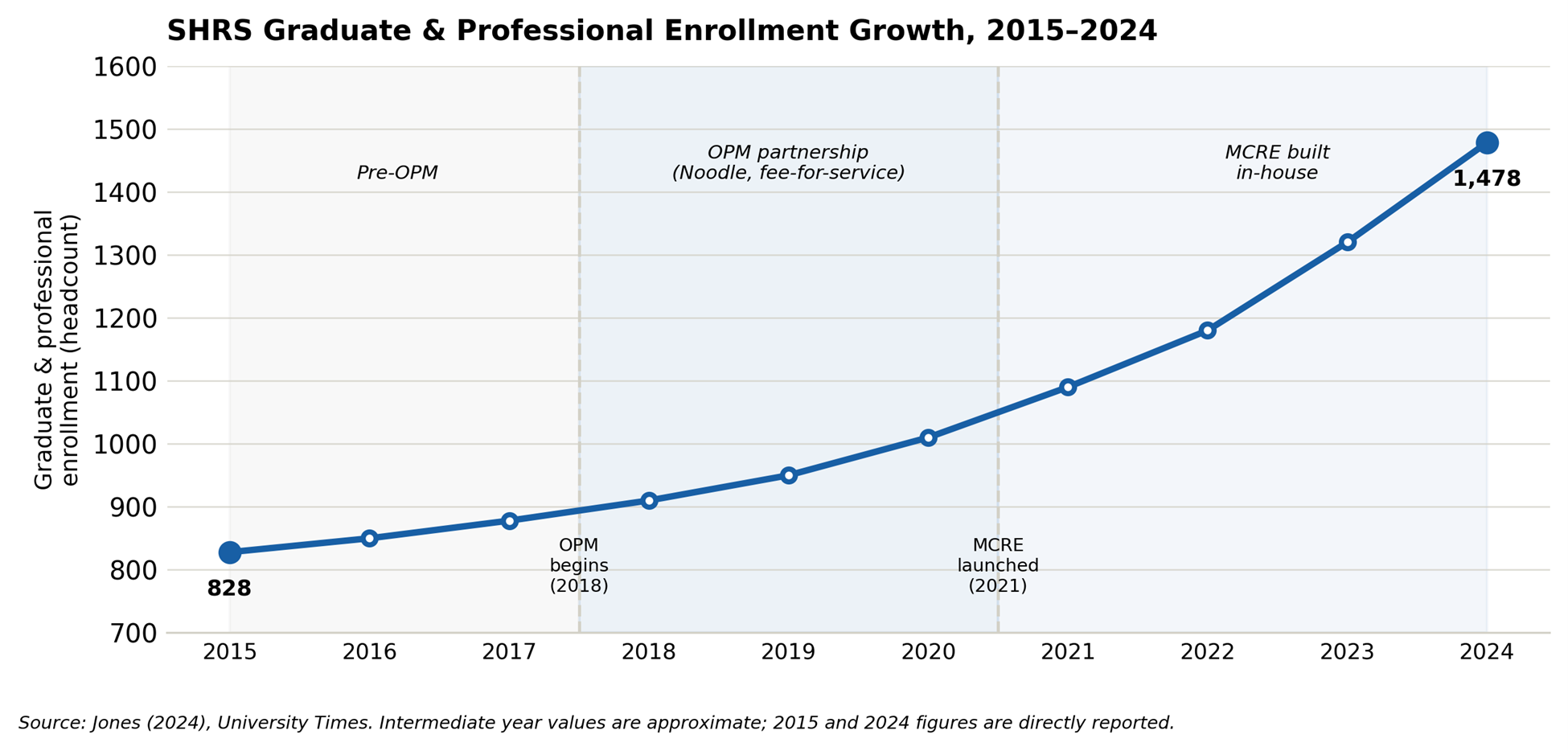
One of the first functions we moved in-house was marketing, recruitment, and enrollment. In 2021, we launched our internal Marketing, Communications, Recruitment, and Enrollment (MCRE) team by restructuring existing positions and strategically adding new ones. We began with seven staff with positions including an executive director, director of recruitment and enrollment, digital marketing manager, email marketing specialist, marketing project manager, communications manager, and an administrator. The team was eventually expanded to a total of 23 members, encompassing seven enrollment specialists, six media, marketing, and web designers, and executive leadership support. The accelerated enrollment trajectory across both the OPM partnership years and in-house MCRE era is illustrated in Figure 1.
Figure 1: SHRS Graduate & Professional Enrollment Growth, 2015–2024
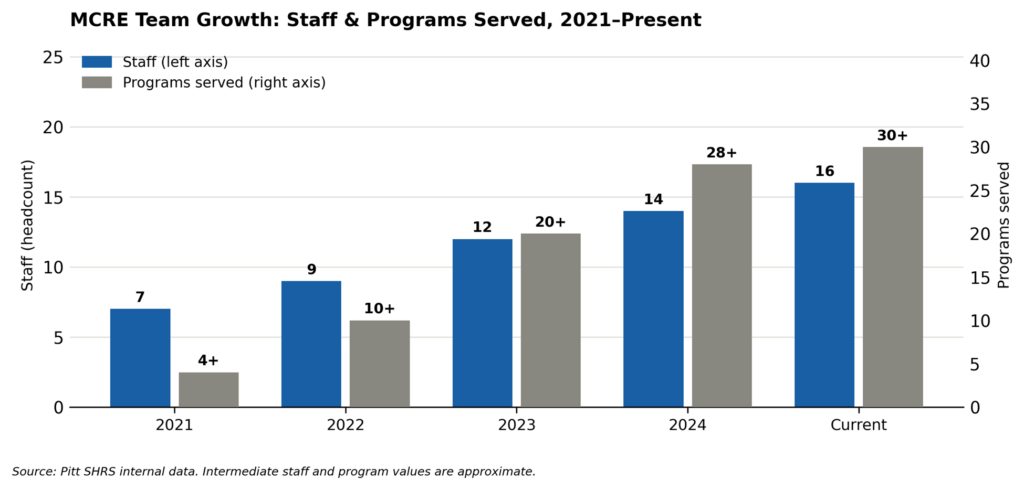
By making strategic investments in human resources at SHRS, we were not only able to move the marketing, recruitment, and enrollment function in-house for online programs, but also for hybrid and residential offerings. The MCRE team now serves all 30-plus academic programs within SHRS across all modalities, not just the four that were initially covered under our OPM contract. Figure 2 displays the commensurate growth of the MCRE team and the number of supported programs since 2021.
Figure 2: MCRE Team Growth: Staff & Programs Served, 2021–Present
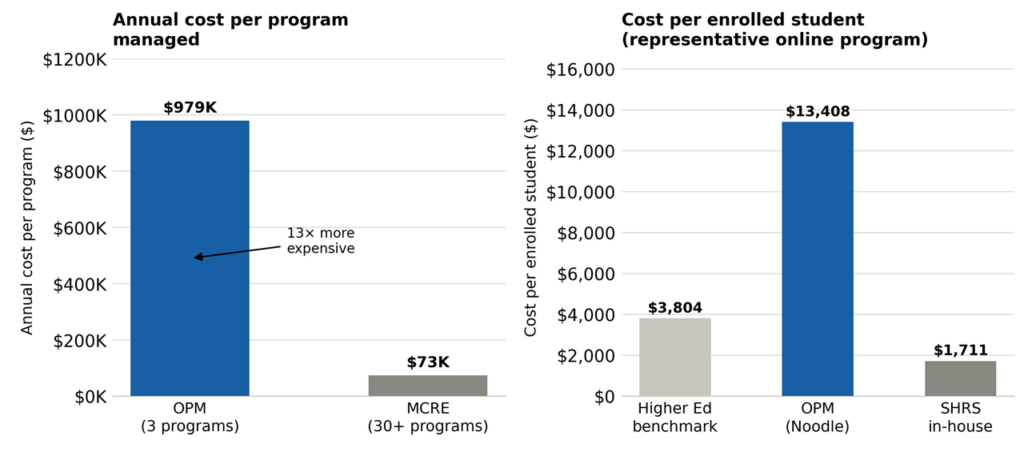
Building the team in-house also yielded considerable cost savings. During our final full year with the OPM managing marketing and enrollment for three online and hybrid programs (2023–2024), these services totaled $2,936,785. At peak engagement, our annual OPM costs had reached as high as $6.1 million. By year 5 of building the MCRE team, our internal personnel costs had reached approximately $1.2 million, plus $1 million in digital marketing, for a total expenditure of roughly $2.2 million, accounting for thirty-plus SHRS programs. By years 6–8, our remaining OPM costs had dropped to approximately $250,000 annually, as we absorbed the final online functions in-house. This cost efficiency is depicted in Figure 3, which compares per-program and per-student costs directly against OPM fees-for-service.
Figure 3: Annual Cost per Program and Cost per Enrolled Student: OPM vs. In-House MCRE
Pitt SHRS is part of a broader movement in higher education that Nguyen and Gilmore (2024) termed “decoupling,” or institutions separating from their OPMs to build in-house capacity and reclaim control of the online enterprise. Other major institutions that have moved in this direction for reasons ranging from cost and mission alignment to faculty involvement and quality control include the University of Central Florida, University of Massachusetts Amherst, Oregon State, Indiana University, Columbia, University of Southern California, and Fordham (Nguyen & Gilmore, 2024; Carey, 2022; Villalobos, 2024; Knox, 2024). Arizona State’s EdPlus has even gone a step further, becoming a self-sustaining internal OPM that now serves other institutions (Knox, 2024).
At Pitt, the success of the SHRS model has been scaled to yield institutional benefits. In September 2024, the University created the Center for Excellence in Digital Education (Pitt EDGE), designed to serve as an internal OPM for the entire institution, providing schools and programs with centralized expertise in instructional design, marketing, enrollment management, and continuing education (McCarthy, 2024). The center’s strategy begins with workforce need and works backward to program format, with goals aligned to Chancellor Gabel’s Plan for Pitt 2028 target of 15% graduate enrollment growth over five years.
For institutions considering the path of outsourcing the online enterprise, whether about to engage an OPM partner, mid-contract, or approaching renewal, we can offer the following recommendations:
The field of online learning is not moving uniformly, and not every institution is prepared or resourced to replicate what SHRS accomplished with the MCRE team. In these instances, OPMs can still serve a purpose for institutions with limited capacity or a limited runway (Palmer, 2025). Nonetheless, the conditions that made the revenue-sharing model attractive, such as uncertainty regarding online quality, absence of internal expertise, and high upfront costs have changed significantly as the online landscape has evolved. We believe that institutions are now positioned to move beyond the model of long-term OPM dependency and hope that our experience at Pitt SHRS experience offers evidence that it can be done as well as confidence that it is worth doing.
*Anthropic Claude was utilized to generate graphics from Pitt raw data.
Carey, S. (2022, April 26). How colleges can get online education right. The Century Foundation. https://tcf.org/content/report/colleges-can-get-online-education-right/
Collegis Education. (2024). DIYing an OPM: Build, outsource, or blend? UPCEA. https://upcea.edu/diying-an-opm-build-outsource-or-blend/
Forrest, P., Judd, R., & Pittman, S. (2025, November 12). Higher education’s uncertain fiscal future. The Pew Charitable Trusts. https://www.pew.org/en/research-and-analysis/articles/2025/11/12/higher-educations-uncertain-fiscal-future
Jones, S. (2024, November 1). Pitt EDGE hopes to build on SHRS success in online programs. University Times. https://www.utimes.pitt.edu/news/pitt-edge-hopes-build
Knox, L. (2024, October 10). Has the OPM market already imploded? Inside Higher Ed. https://www.insidehighered.com/news/tech-innovation/teaching-learning/2024/10/10/report-online-program-manager-growth-slows
Mancilla, R., & Cochenour, J. (2024). Building and managing successful university–OPM partnerships: Insights from the University of Pittsburgh and Noodle. In C. Nguyen & D. M. Gilmore (Eds.), Online program management: Evolving approaches by OPM providers and higher education institutions to drive success, innovation, and remain relevant (pp. 38–58). Routledge. https://doi.org/10.4324/9781003387138
Nguyen, C., & Gilmore, D. M. (2024). An introduction to online program management (OPM): Evolving approaches by OPM providers and higher education institutions. In C. Nguyen & D. M. Gilmore (Eds.), Online program management: Evolving approaches by OPM providers and higher education institutions to drive success, innovation, and remain relevant (pp. 1–27). Routledge. https://doi.org/10.4324/9781003387138
McCarthy, J. (2024, September 24). Anthony Delitto will lead Pitt’s new Center for Excellence in Digital Education. Pittwire, University of Pittsburgh. https://www.pittwire.pitt.edu/pittwire/features-articles/2024/09/24/pitt-edge-online-hybrid-learning
Nyre, J. E. (2025, June 23). Financial pressures could have cascading effects. Inside Higher Ed. https://www.insidehighered.com/opinion/views/2025/06/23/financial-pressures-could-have-cascading-effects-opinion
Palmer, K. (2025, February 19). Fewer colleges sharing profits with OPMs. Inside Higher Ed. https://www.insidehighered.com/news/tech-innovation/teaching-learning/2025/02/19/fewer-colleges-sharing-profits-opms
Villalobos, A. (2024, April 9). Universities are getting wise to the dubious practices of online program contractors. The Century Foundation. https://tcf.org/content/commentary/universities-are-getting-wise-to-the-dubious-practices-of-online-program-contractors/

Executive Director of University Digital Education, University of Pittsburgh Center for Excellence in Digital Education (Pitt EDGE)

Executive Director for Digital Enrollment, University of Pittsburgh Center for Excellence in Digital Education (Pitt EDGE)

Associate Provost for Digital Education, University of Pittsburgh Center for Excellence in Digital Education (Pitt EDGE)