Report: Online Students and Faculty are Aligned on GenAI Use
Published by: WCET | 6/11/2026
Published by: WCET | 6/11/2026
By Mary Ellen Dello Stritto, PhD, and Naomi Aguiar, PhD
You’ve likely heard that students and faculty are on opposing sides in their perceptions of how generative AI (GenAI) tools are used in higher education. These narratives are based on assumptions and stem from personal stories or any number of recently published opinion pieces.
To learn what the reality is, the Ecampus Research Unit at Oregon State University conducted mixed-method survey research over the course of two years (2023-2025), examining both online students’ and online instructors’ perceptions of GenAI tools.
Our findings—with over 1,600 respondents—tell a different story: Both online instructors and online learners share similar perceptions of GenAI tools.
In our surveys, both online students and faculty reported using GenAI tools for coursework and work (59% of faculty in 2025 and 43% of students in 2024). The top uses of GenAI tools for both online students and instructors were “brainstorming/generating ideas” (71% of faculty and 66% students), “proofreading content” (38% of faculty and 42% students) and “summarizing and synthesizing content” (36% faculty and 46% students).
Until recently, headlines reported that college students are enthusiastic adopters of GenAI tools, and that faculty need to get on board or get left behind. However, our research paints a more nuanced picture. Nearly half of online students (48%) and more than half of faculty (59%) reported mixed emotions about GenAI tools.
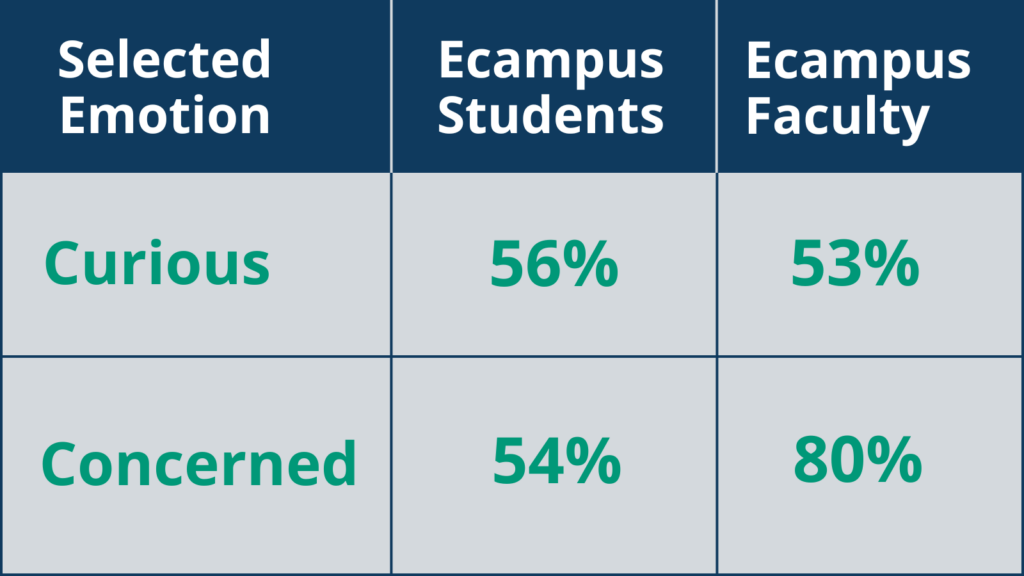
When asked to select from a list of emotions describing how they feel about these tools, “curious” and “concerned” were the most frequently selected emotions—among students and faculty alike. When given the option to write in their own emotions about GenAI tools, the number one emotion that both groups reported was “anger;” online students also reported feelings of “frustration, disappointment, and annoyance” about as often as faculty did.
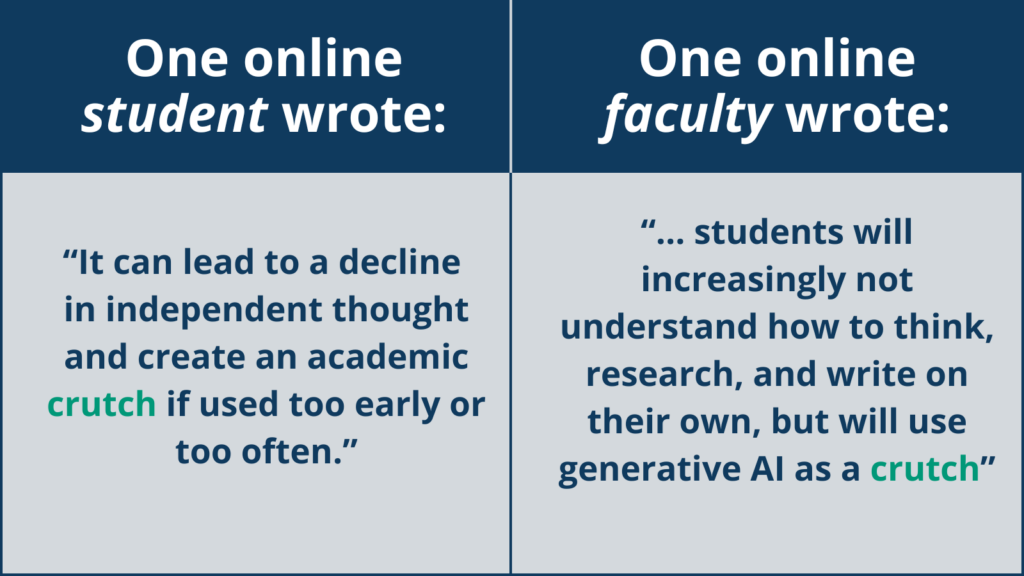
In addition to mixed feelings about GenAI, both online students and faculty expressed similar hopes and concerns about the tools. In open-ended questions, both online students and faculty expressed fewer hopes than concerns, and students and faculty reported similar concerns that were nuanced, detailed, and specific. Both groups expressed concerns about the quality of information produced by GenAI tools, the possible negative impacts on student learning, and the consequences of overreliance on these tools. Sometimes, student and faculty responses included the same words or phrases:
Across both online student and faculty responses, we found far more alignment than misalignment in perceptions of GenAI tools. However, there were a few notable exceptions, one being how each group perceived GenAI tools and academic integrity. In open-ended responses, online students sometimes reported concerns about being accused of using GenAI tools irresponsibly or to cheat when they were not using them. Despite student concerns, most of the online faculty indicated that the majority of their students were not misusing GenAI tools. So, online students may be even more concerned about GenAI tools and academic integrity than their instructors.
Overall, OSU Ecampus Research Unit’s research findings indicate that online students and faculty are far more aligned in their perceptions of GenAI tools than might be expected. This is good news—especially given concerns about the potential for AI tools to break down trust between students and faculty.
Instead of media narratives, digital learning leaders should look toward research in order to support online students and faculty. We can offer three recommendations based on our OSU Ecampus Research Unit’s results:
Dive deeper into OSU’s Ecampus reports, studies, and resources on supporting online students and faculty in the age of AI.
Remember, online students and faculty are on the same side—and that is reason enough to be hopeful about the future of online education.

Director of Research, Oregon State University Ecampus

Associate Director of Research, Oregon State University Ecampus