A Historian and Accidental Technologist's View of Higher Education's AI Moment
Published by: WCET | 7/2/2026
Tags: Artificial Intelligence, Managing Digital Learning, Technology
Published by: WCET | 7/2/2026
Tags: Artificial Intelligence, Managing Digital Learning, Technology
By Van L. Davis, Ph.D.
Hi, I’m Van, and I’m an accidental technologist. (A what? I know. Just stick with me.)
The first time I encountered the internet, I was sitting at a terminal in Vanderbilt University’s computer science building, which still housed the mainframe. It was the early ’90s, and I used that terminal to log into the National Archives and pull up the text of the United States Constitution. Hardly earth-shattering, but it felt monumental at the time.
Fast forward to my first teaching job at a public liberal arts university in rural Missouri. A student in my U.S. history survey course turned in a research paper with virtually no resources except a lone website: an elementary school class project. I realized that, whether I liked it or not, my students were going to use the internet, and we would need to have a conversation about its ethical and responsible academic use.
I eventually left teaching to become a state policymaker focused on digital learning as a way of expanding educational access, especially for those learners who were bound by time and place. I then joined an edtech company before becoming WCET’s executive director and WICHE’s vice president for digital learning.
Why share this? Because my views on educational technology and the transformation of higher education are still rooted in those early experiences with digital learning: The wonder of sitting at that Vanderbilt computer terminal. The frustration with my student’s citation (or lack thereof). And finally, the joy of watching a group of returning adults complete their bachelor’s degree via Texas’s first online competency-based education program. Those experiences cemented my belief that educational technology can be transformational–not because of the technological tools, but because of the humans who wield those tools.
The idea that technology drives educational innovation is not new or unique to our current AI moment. In 1960, the University of Illinois developed Programmed Logic for Automated Teaching Operations (PLATO) as one of the earliest forms of what was, at the time, called computer-assisted instruction. The earliest form of PLATO was a handful of terminals networked to Illinois’s mainframe, although by 1972, PLATO IV reached thousands of students through rudimentary touchscreens and early forms of online community features such as email and social networks. Regardless of how innovative PLATO was for its time, it never amounted to transformation and only changed higher education around the edges.
There are two other technological shifts that I want to draw your attention to: The emergence of the World Wide Web and Massive Open Online Courses (MOOCs). You may remember the days prior to the 1991 development of the world wide web. And, maybe more importantly, we remember those early promises of the internet—the development of instantaneous international communications that would foster global understanding and reduce cultural barriers, the strengthening of democracy through the development of an informed citizenry, the democratization of information when anyone could publish and access knowledge, and an expansion of educational opportunities. (The cynic in me is tempted to respond “And how’d that work out for us?)” Certainly, the internet has transformed society, but not in all of the ways that we were promised. One could argue that it has led to further fracturing of the social order rather than unifying it. And although it has undoubtedly expanded educational opportunity with the explosion of online education, the overwhelming majority of higher education institutions still inhabit physical campuses. It certainly hasn’t replaced the university as some pundits predicted.
Then there are MOOCs. At the height of MOOC madness, The New York Times proclaimed 2012 to be “The year of the MOOC.” MOOCs were supposed to radically change education as we know it by extending unprecedented access to courses from the most prominent scholars all over the world. MOOCs would, proponents argued, allow students to learn from the world’s best and brightest scholars, all without leaving the comfort of their homes. No longer would students be limited by location or time, and no longer would institutions be limited by the confines of the classroom. Instead of teaching a few hundred students, institutions, the argument went, could reach tens of thousands of students. In fact, in 2012, William G. Bowen (the same William Bowen who developed with William Baumol the idea of higher education’s cost disease) proclaimed to an audience at Stanford, “I continue to believe that the potential for online learning to help reduce costs without adversely affecting educational outcomes is very real.”
Yet 14 years later, MOOCs have not radically changed higher education’s model. Institutions are not enrolling thousands of students in credit-bearing courses, and MOOCs have not transformed the delivery of higher education. Yes, students continue to enroll in MOOCs, but those tend to be career professionals who are upskilling or reskilling and may or may not choose to pursue a credential. And anyone who has spent any amount of time in a MOOC can certify that while they may be good at transmitting knowledge to large swaths of learners, they do not excel at engaging those learners (rarely is there interaction between learners or with an instructor or teaching assistant). MOOC learning is, for many participants, a lonely affair—the opposite of what we know high-quality digital learning should be.
We talk a lot about digital transformation, but I challenge us to consider the extent to which we are transforming higher education—especially now in this age of artificial intelligence. In October 2025, Gallup found that 79% of 18-28-year-olds believe that AI is making people lazier, and 62% believe that AI makes people less smart and especially harms learning by doing, thinking critically, and learning from other people. At the same time, those students are using AI. Lumina and Gallup’s 2026 State of Higher Education survey found that 57% of higher education students reported using AI in their coursework at least weekly. Which leads to the question:
How is AI currently impacting higher education and how should it be incorporated into higher education in the future?
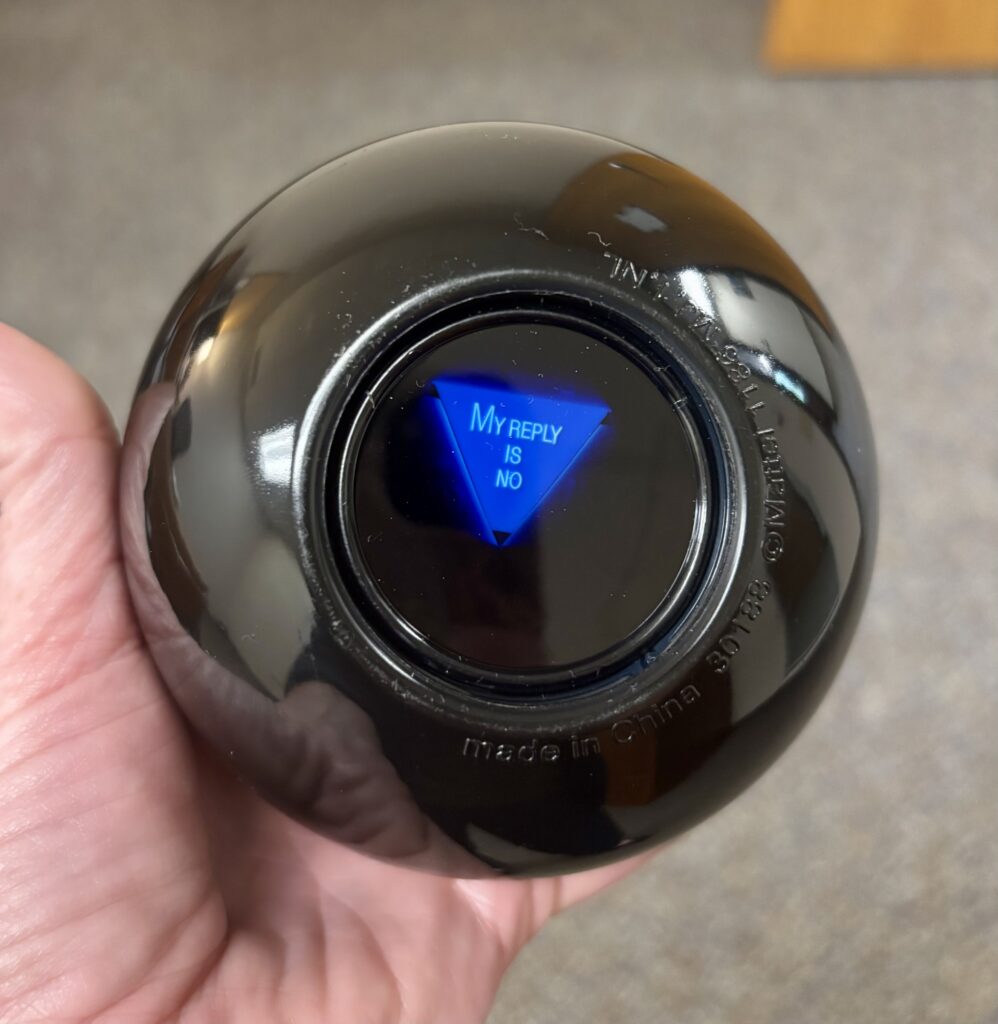
Is AI the golden technology that is going to fundamentally change higher education? I don’t know. The Magic 8 Ball in my office says, “My reply is No.” Based on how higher education has responded to technological changes in the past, I doubt it. Does that relieve us from grappling with AI or teaching our students how and when to use it? I don’t think so. The genie is out of the bottle, and I doubt that we will be able to put it back in. However, it does force us to consider what unique human traits our graduates will need in an AI-laden world.
How can we teach students about critical thinking, creative decision making, ethical and responsible use, and the importance of keeping humans in the loop?
How do we create AI literate students, faculty, and staff, and what does it even mean to be AI literate?
These are the sorts of questions we are grappling with at WCET, and they are guiding our ongoing work on AI literacies, institutional policies, and emerging promising practices.
This accidental technologist has lived through the emergence of the internet, the development of learning management systems, the year of the MOOC, and so many other technological developments—and regardless of whether or not these have fundamentally altered higher education, I remain optimistic. With each technological development, we have slowly shifted who our learners are and how we serve them. I still find myself getting excited by the opportunities that new technologies deliver! As much wonder as I experienced sitting at that Vanderbilt computer terminal in the early 1990s, I have experienced even more with the emergence of AI.
No, it is not a panacea and there are very real dangers inherent in tech so powerful, but I would urge us all to heed the words of Ryan Baker, who leads the University of Pennsylvania’s Learning Analytics Center. When asked about the goal of AI in higher education, Baker responded, “… the ultimate goal of the field of Artificial Intelligence in Education is not to promote artificial intelligence, but to promote education. In the end, our goal is not to create intelligent tutoring systems or stupid tutoring systems, but to create intelligent and successful students.”