Rae Mancilla’s Vision for Digital Learning: Expanding Access, Empowering Learners, and Growing Leaders
Published by: WCET | 10/29/2026
Tags: Digital Learning, Managing Digital Learning, Online Learning, WCET Awards
Published by: WCET | 10/29/2026
Tags: Digital Learning, Managing Digital Learning, Online Learning, WCET Awards
The 2026 Sally M. Johnstone Award recipient has spent her career building opportunities for online learners, strengthening digital learning at the University of Pittsburgh and investing in the people who make it possible.
by Betsy Piland
Rae Mancilla, Ed.D., is certain that, buried in a family photo album somewhere, her parents still have a picture of young Rae, standing at a chalkboard, teaching a room full of students—who just happened to be stuffed animals.
Teaching was what she had wanted to do from an early age. Although her career would eventually take her from the classroom into instructional design and university leadership, she never lost the desire to help others learn.
“It’s interesting, because when I was becoming a teacher, everybody said, ‘Those who can’t do, teach.’ I always resented that. I thought, I can do it better because I’m teaching it.”
Mancilla began her professional career as a teacher before moving into higher education, where she found new ways to put that passion into practice. Her path took her through instructional design, faculty support, and program leadership, eventually leading her to help shape digital learning across the University of Pittsburgh—though, it wasn’t a trajectory she had mapped out in advance.
“I love to see how careers take shape. I had no idea I’d be doing what I’m doing even five or 10 years ago. I had a background in learning design, but I never thought, ‘I’ll become an instructional designer, then an assistant director, then an executive director, then a director at the university.’ It wasn’t my plan.”
Today, Mancilla brings that experience to her work as executive director of digital learning at Pitt EDGE, the University of Pittsburgh’s Center for Excellence in Digital Education. Her career has included leading the development of online and hybrid graduate health professions programs, mentoring faculty in digital teaching and course design, and advancing digital accessibility.
Her work reflects a belief that education should open doors for learners who might not otherwise have the opportunity to pursue their goals. It also demonstrates a commitment to developing the people who make meaningful learning experiences possible.
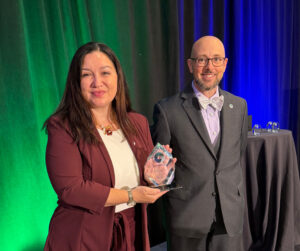
In recognition of her leadership, innovation, and service to the digital learning community, Mancilla received this year’s Sally M. Johnstone Award for Excellence in Digital Learning Practice, presented to her at the 2026 WCET Annual Conference in Minneapolis.
For Mancilla, the recognition affirmed something that can be difficult to see when much of a leader’s work happens behind the scenes.
“Deep down, you know you’re touching lives, but to be nominated for an award at the national level, with such a wonderful legacy as the Johnstone Award, really reaffirmed that what I’m doing matters.”
Mancilla explains that expanding access to digital learning has always been about more than moving courses online. It is about opening doors to professions that might otherwise remain out of reach, helping learners advance their careers without leaving their communities, and building the support systems that allow students to succeed.
“When I was working in the School of Health and Rehabilitation Sciences, where we did this work primarily in the health sciences professions, it was a dean’s-level initiative. At the time, there was no online operation at the University of Pittsburgh. We set out to increase access. The mission was to diversify the student body and provide access to underserved populations who would not otherwise be able to become physician assistants or physical therapists. That’s what resonated with me when I moved over to SHRS.”
Mancilla saw the potential of online education to reach people whose professional ambitions and personal responsibilities made traditional, campus-based programs difficult to pursue. For working professionals, parents, caregivers, and other nontraditional learners, earning a degree can require navigating substantial logistical and financial challenges. Aspiring health care professionals are presented with additional complexities because of the hands-on clinical requirements.
Mancilla and her colleagues set out to design programs that could reach students across the country while preserving the in-person experiences necessary for their education.
“This was education that used to have to happen in a laboratory setting. It was a complex process to design curricula so students could come to campus for on-site clinical immersions and clinical assessments, but at a price point that was still affordable and in a way that still worked with their schedules.”
The goal extended beyond making a degree more convenient to earn. It was also about helping students develop their expertise while continuing to serve the communities where they lived and worked.
“Pittsburgh is a healthcare hub, so we were able to leverage that expertise, allowing clinicians to stay in their communities and continue to serve underserved populations there. Instead of coming to Pitt as a residential learner and being drawn to stay in this healthcare hub, they could carry that expertise back to their own areas, many of them being in rural settings.”
The little girl who once lined up her stuffed animals to teach them has grown into a leader who creates opportunities for others. For Mancilla, that may be the most meaningful measure of success.