Interoperability Standards Are the Foundation for Emerging Workforce Policies
Published by: WCET | 3/17/2026
Published by: WCET | 3/17/2026
Federal and state policymakers are increasingly signaling that the future of workforce development, postsecondary education, and industry alignment is dependent on integrating systems and strategies. Recent policy actions, including the expansion of Workforce Pell, increased flexibility in Workforce Innovation and Opportunity Act (WIOA) implementation, federal investments through the Fund for the Improvement of Postsecondary Education (FIPSE), along with initiatives such as the Connecting Talent to Opportunity (CTO) Challenge, reflect a growing emphasis on modernization of technology infrastructure to support industry-aligned training, learner mobility, skills transparency, and cross-sector coordination.
Interoperability is a critical enabler of this work as policymakers seek to expand industry-aligned educational opportunities while strengthening quality assurance, accountability, and labor market outcomes. Shared technology and data standards are the foundation needed to implement these policies efficiently and reduce fragmentation, ultimately supporting learners in navigating flexible and affordable pathways and providing employers with appropriately skilled talent.
Workforce Pell represents a significant policy shift by extending Pell Grant eligibility to high-quality, short-term programs aligned to workforce needs. While the opportunity is substantial, so are the implementation challenges. Institutions must demonstrate program quality, collect and report outcomes data, track financial aid usage, and support learners as they navigate new eligibility requirements and pathways.
These demands cannot be sustained with the current state of disconnected systems or manual processes. Institutions need interoperable infrastructure that allows financial aid, student information systems, learning platforms, and credentialing systems to work together. They also need ways to communicate their learning outcomes and what they mean beyond institutional borders. To meet these needs, institutions and states are being encouraged to collect richer data while also reducing administrative burden and protecting learner privacy – not just for Workforce Pell, but for improved student longitudinal data systems and other reporting that will enable a greater understanding of educational quality and outcomes.
Shared standards make this balance possible. Standards like 1EdTech’s OneRoster and Edu-API reduce friction in data collection and reporting, while digital credential and skill standards like Open Badges, the Comprehensive Learner Record Standard (CLR Standard), and Competency and Academic Standards Exchange (CASE) make it possible to deliver verifiable and portable records of achievement.
1EdTech’s interoperability standards would allow information to be captured once and reused for multiple purposes: from compliance to reporting to learner support. For example, standards-based systems can enable proactive notifications to students as they approach Pell eligibility limits, document skills attained through credential pathways, and support coordinated reporting across education and workforce agencies, all at once. For learners, this means improved navigation and portability with credentials that can be shared across education, workforce, and employment systems without these achievements losing meaning. For institutions and systems, this means reduced labor in reporting and a greater ability to tailor assistance for learners.
Workforce Pell aims to support quality short-term training to connect learners to high-wage jobs, representing just one approach in a holistic strategy to build a coordinated system that makes learning more flexible, achievements more transparent, and skills-based hiring more seamless. Federal guidance through FIPSE, the CTO Challenge, and the modification of WIOA requirements emphasizes the importance of interoperability standards as the connective tissue that aligns technology, data, and practice across education and workforce systems.
In particular, the CTO Challenge advances an ambitious vision of a statewide talent marketplace: a publicly available, AI-enabled ecosystem that promotes skills-based hiring and integrates learning and employment records (LERs), credential and skills information, and skills-based job descriptions. This vision depends on the ability to transform learning achievements and job requirements into interoperable data.
That level of integration requires standards by design, or else states risk investing in technology that doesn’t easily connect or requires bespoke, cumbersome integrations every time a new platform is introduced. 1EdTech’s open standards — standards like Open Badges, the CLR, and CASE – serve as the “Rosetta Stone” to build LERs that seamlessly integrate within and across state lines, so that skills and competencies are easy to share, access, and understand.
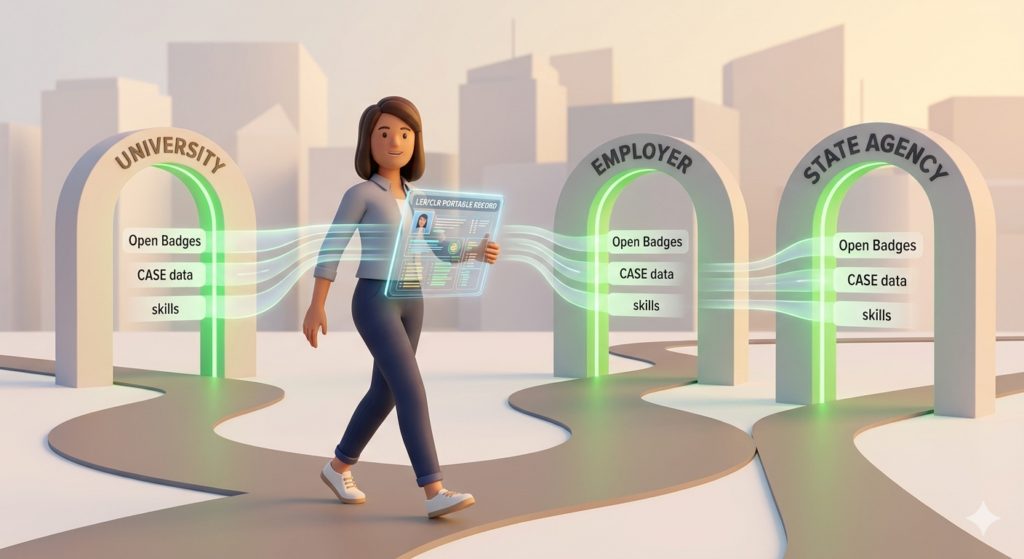
Workforce Pell, FIPSE priorities, and the CTO Challenge all point to the same conclusion: building a system that supports modern, ever-changing workforce needs requires an interoperable infrastructure. Open interoperability standards enable a vendor-neutral foundation for future-ready talent marketplaces. As policymakers continue to invest in workforce development, shared standards will be essential to ensuring that opportunity is truly portable—and that learners can carry their achievements wherever their paths lead.
As states, systems, and institutions work together to make this vision a reality, they should require that all participating edtech providers certify or conform to relevant standards, ensuring a shared interoperability approach and ability to independently validate adherence to standards.

1EdTech and WCET communities will continue to serve as resources and conveners for the broader community, supporting standards-based technology implementation and helping stakeholders stay up to date on emerging workforce and education policy.
Authors: Megan Raymond, WCET, and Emilie Rafal, 1EdTech


Senior Director, Postsecondary Education and Workforce Programs, 1EdTech