By Mary Ellen Dello Stritto, PhD, and Naomi Aguiar, PhD

You’ve likely heard that students and faculty are on opposing sides in their perceptions of how generative AI (GenAI) tools are used in higher education. These narratives are based on assumptions and stem from personal stories or any number of recently published opinion pieces.

To learn what the reality is, the Ecampus Research Unit at Oregon State University conducted mixed-method survey research over the course of two years (2023-2025), examining both online students’ and online instructors’ perceptions of GenAI tools.

Our findings—with over 1,600 respondents—tell a different story: Both online instructors and online learners share similar perceptions of GenAI tools.

1. Both online students and faculty were using GenAI tools in similar ways.

In our surveys, both online students and faculty reported using GenAI tools for coursework and work (59% of faculty in 2025 and 43% of students in 2024). The top uses of GenAI tools for both online students and instructors were “brainstorming/generating ideas” (71% of faculty and 66% students), “proofreading content” (38% of faculty and 42% students) and “summarizing and synthesizing content” (36% faculty and 46% students).

2. Both online students and faculty had mixed emotions about GenAI tools.

Until recently, headlines reported that college students are enthusiastic adopters of GenAI tools, and that faculty need to get on board or get left behind. However, our research paints a more nuanced picture. Nearly half of online students (48%) and more than half of faculty (59%) reported mixed emotions about GenAI tools.
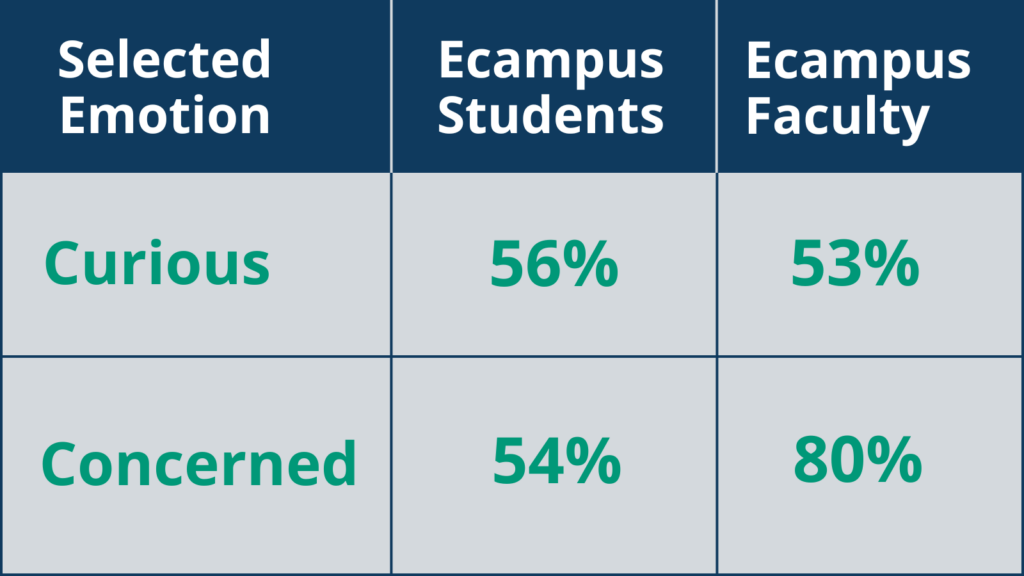
Graphic that displays data: 48% of online students and 59% of faculty reported mixed emotions about GenAI tools. When asked to select from a list of emotions describing how they feel about these tools, “curious” and “concerned” were the most frequently selected emotions—among students and faculty.

When asked to select from a list of emotions describing how they feel about these tools, “curious” and “concerned” were the most frequently selected emotions—among students and faculty alike. When given the option to write in their own emotions about GenAI tools, the number one emotion that both groups reported was “anger;” online students also reported feelings of “frustration, disappointment, and annoyance” about as often as faculty did.

3. Online students and faculty expressed similar hopes and concerns about GenAI tools.

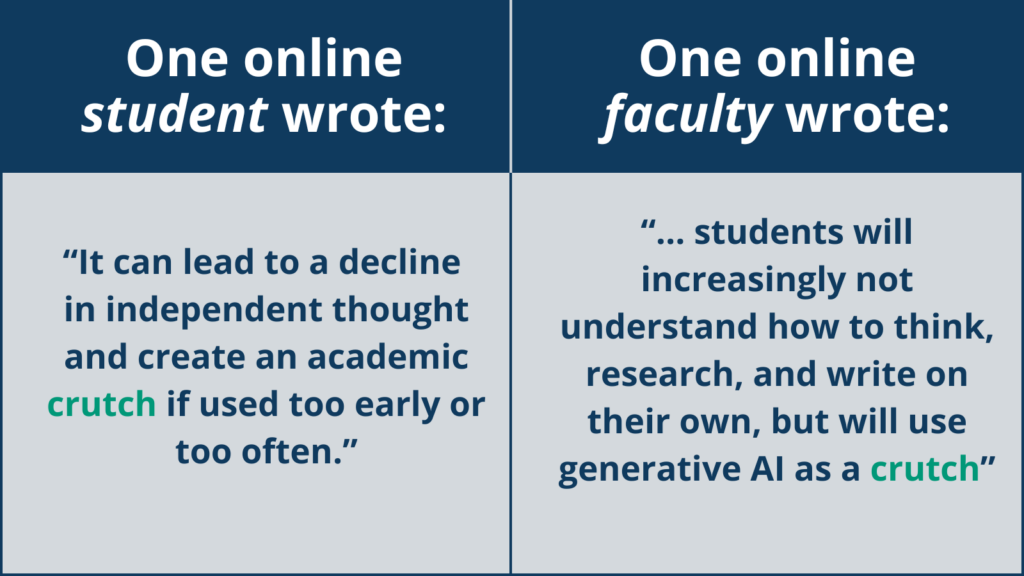
In addition to mixed feelings about GenAI, both online students and faculty expressed similar hopes and concerns about the tools. In open-ended questions, both online students and faculty expressed fewer hopes than concerns, and students and faculty reported similar concerns that were nuanced, detailed, and specific. Both groups expressed concerns about the quality of information produced by GenAI tools, the possible negative impacts on student learning, and the consequences of overreliance on these tools. Sometimes, student and faculty responses included the same words or phrases:
4. Misalignment was rare and not in ways you might expect.

Across both online student and faculty responses, we found far more alignment than misalignment in perceptions of GenAI tools. However, there were a few notable exceptions, one being how each group perceived GenAI tools and academic integrity. In open-ended responses, online students sometimes reported concerns about being accused of using GenAI tools irresponsibly or to cheat when they were not using them. Despite student concerns, most of the online faculty indicated that the majority of their students were not misusing GenAI tools. So, online students may be even more concerned about GenAI tools and academic integrity than their instructors.

Our research contradicts the belief that students and faculty are on opposite sides.

Overall, OSU Ecampus Research Unit’s research findings indicate that online students and faculty are far more aligned in their perceptions of GenAI tools than might be expected. This is good news—especially given concerns about the potential for AI tools to break down trust between students and faculty.

Instead of media narratives, digital learning leaders should look toward research in order to support online students and faculty. We can offer three recommendations based on our OSU Ecampus Research Unit’s results:

  1. Keep human connection at the center of online teaching and learning by using AI tools to support student/instructor relationships.
  2. Develop and promote opportunities for both online students and instructors to enhance their AI literacy skills, with a clear focus on responsible use.
  3. Online instructors should engage online students in discussions about course policies related to AI use throughout the academic term.

Dive deeper into OSU’s Ecampus reports, studies, and resources on supporting online students and faculty in the age of AI.

Remember, online students and faculty are on the same side—and that is reason enough to be hopeful about the future of online education.

Mary Ellen Dello Stritto

Director of Research, Oregon State University Ecampus

Naomi Aguiar

Associate Director of Research, Oregon State University Ecampus

Subscribe

Enter your email address to subscribe to this blog and receive notifications of new posts by email.

Join 1,442 other subscribers

Archive By Month

Blog Tags

Distance Education (391)Student Success (350)Managing Digital Learning (290)Online Learning (287)WCET (248)State Authorization (245)U.S. Department of Education (227)Regulation (225)Digital Learning (205)Technology (183)Innovation (126)Teaching (122)Collaboration/Community (116)SAN (110)WCET Annual Conference (106)Course Design (103)Professional Development (103)Access (101)Faculty (90)Cost of Instruction (89)Financial Aid (85)Legislation (83)Accessibility (74)Completion (74)Assessment (68)Professional Licensure (68)SARA (68)Instructional Design (67)Open Educational Resources (66)Accreditation (66)Quality (65)Credentials (64)COVID-19 (63)Competency-based Education (61)Reciprocity (60)Data and Analytics (59)Research (58)WOW Award (57)Diversity/Equity/Inclusion (53)Workforce/Employment (51)Artificial Intelligence (50)Negotiated Rulemaking (50)Outcomes (46)Regular and Substantive Interaction (43)Higher Education Act (42)Policy (41)State Authorization Network (41)Virtual/Augmented Reality (37)Title IV (36)Leadership (35)Practice (35)Disaster Planning/Recovery (34)Academic Integrity (32)Every Learner Everywhere (32)WCET Awards (30)IPEDS (28)Adaptive/Personalized Learning (28)Reauthorization (28)Military and Veterans (27)Survey (27)Credits (26)Disabilities (24)MOOC (23)WCET Summit (23)Retention (22)Evaluation (22)Complaint Process (21)Enrollment (21)WICHE (20)Correspondence Course (18)Physical Presence (17)System/Consortia (16)WCET Webcast (16)Products and Services (16)Blended/Hybrid Learning (15)Cybersecurity (15)Forprofit Universities (15)Member-Only (15)Digital Divide (14)Mobile Learning (14)NCOER (14)Textbooks (14)Consortia (13)Futures (12)Personalized Learning (12)Marketing (11)Privacy (11)Prior Learning Assessment (10)Courseware (10)Teacher Prep (10)Social Media (9)LMS (9)Rankings (9)Standards (8)Student Authentication (8)Partnership (8)Remote Learning (7)Tuition and Fees (7)Readiness and Developmental Courses (7)Graduation (7)What's Next (7)International Students (6)K-12 (6)Nursing (6)STEM (6)Testing (6)Lab Courses (5)Proctoring (5)Closer Conversation (5)ROI (5)DETA (5)Game-based/Gamification (5)Department of Education (5)Dual Enrollment (4)Outsourcing (4)Coding (4)Security (4)Higher Education Trends (4)Mental Health (4)Virtual Summit (4)Fall and Beyond Series (3)In a Time of Crisis (3)Net Neutrality (3)Universal Design for Learning (3)Cheating Syndicates Series (3)ChatGPT (3)Enrollment Shift (3)Minority Serving Institution (3)Compliance (3)toolkit (3)Nontraditional Learners (2)Student Identity Verification (2)Cross Skilling/Reskilling (2)Higher Education (2)Community College (2)Licensure (2)rubric (2)Title IX (1)Business of Higher Education (1)OPMs (1)Third-Party Servicers (1)microcredentials (1)equity (1)Formerly Incarcerated Students (1)Global (1)Cost & Price (1)experts (1)Digital Learning Operations (1)WCET Member Feature (1)Student Voice (1)ASWE (1)Reflection (1)Gainful Employment (1)benefits (1)AHEAD (1)Course Catalog (1)Workforce Pell (1)1EdTech (1)Agentic Ai (1)community (1)Awards (1)Accesssibility (1)