Tracking New Federal Financial Aid Regulations: Effective Dates, Court Actions, and Statutory Implementation
Published by: WCET | 7/9/2026
Published by: WCET | 7/9/2026
By Cheryl M. Dowd
The timing of federal financial aid regulations is unusually complex this year. Instead of the traditional July 1 implementation cycle, institutions are navigating a mix of regulations that have been delayed, accelerated, or temporarily blocked by court action. As a result, understanding not only what has changed, but also when those changes take effect, is essential for institutional planning.
This article reviews these developments chronologically, beginning with final regulations issued at the end of the Biden administration, followed by regulations issued during the Trump administration under the traditional regulatory timeline, and concluding with regulations implementing the One Big Beautiful Bill/Working Families Tax Cut Act, which follow an accelerated schedule established by Congress.
Editor’s note: The One Big Beautiful Bill was the initial, informal name of this legislation; today, the Working Families Tax Cut Act is the official name used by the administration.
As a reminder, the Higher Education Act (HEA) establishes a regulatory timeline process known as the master calendar for regulations affecting the Title IV federal student aid programs. Under this process, final regulations published by Nov. 1 generally become effective on the following July 1. Regulations published after Nov. 1 typically do not become effective until the subsequent July 1, providing institutions time to prepare for implementation before the start of a new award year. The HEA also authorizes the Secretary of Education to permit optional early implementation of certain regulations.
The regulations implementing OB3 depart from this traditional timeline. Because Congress required implementation of the statutory changes by July 1, 2026, the U.S. Department of Education (Department) concluded that these regulations should become effective on an accelerated schedule. Combined with ongoing judicial challenges affecting several recent regulations, institutions should carefully review the effective date and implementation status of each rule rather than assuming the traditional July 1 timeline applies.
The Biden administration released final distance education regulations in early January 2025 just weeks before leaving office. Among the changes, the regulations establish a federal definition of a distance education course. The new definition codifies that a course may continue to be classified as distance education even if it includes in-person, non-instructional requirements. Additionally, the new regulations create federal reporting expectations for students receiving Title IV aid who enroll in distance education or correspondence courses in accordance with procedures established by the Secretary.
Because these regulations were published after the Nov. 1 Higher Education Act master calendar deadline, they do not become effective until July 1, 2026. However, the new enrollment reporting requirement, while effective on that date, is not scheduled to be implemented until July 1, 2027. As of now, the Department has not yet issued guidance on the reporting procedures institutions will be expected to follow.
The first negotiated rulemaking of the second Trump administration was held in late June and early July 2025 to revise the definition of a qualified employer for the Public Service Loan Forgiveness (PSLF) program. The final rule would have excluded organizations determined by the Department to engage in activities with a “substantial illegal purpose” from qualifying as eligible public service employers.
The rule followed the Higher Education Act master calendar and was scheduled to become effective on July 1, 2026. However, on that same day, two federal district courts issued orders preventing the rule from taking effect. The courts concluded that the Department likely exceeded its statutory authority by redefining “public service” beyond what Congress intended when it established the PSLF program and raised constitutional concerns. As of this writing, it is uncertain whether the Department will appeal the decisions.
Had it taken effect, the rule would have allowed the Department to determine that certain employers were ineligible for PSLF based on a finding that they had a substantial illegal purpose. For colleges and universities, public agencies, and nonprofit organizations, the rule would have created new uncertainty regarding employer eligibility, borrower communications, and the potential impact of future Department determinations on employees seeking PSLF credit.
The Reimagining and Improving Student Education-Federal Student Loan Program (RISE) regulatory package implements federal student loan changes required by OB3, including the phase-out of Grad PLUS Loans for new borrowers, new annual and aggregate loan limits for graduate and professional students, revised borrowing limits for parent borrowers, and changes to available repayment plans. The final regulations became effective on July 1, 2026.
One aspect of the regulations remains subject to litigation. To implement OB3, the Department adopted a regulatory definition of a professional degree that determines which programs qualify for the higher professional student loan limits. Before the rule could take effect, a federal court temporarily blocked the Department’s narrowed professional degree definition pending final resolution of litigation. Despite the court’s order for a stay of implementation, institutions must continue to implement the loan limits for graduate and professional students.
In response to the court’s order, the Department released (GENERAL-26-42) Update to List of Professional Degree Programs Due to Court Order identifying the programs it will treat as professional degree programs while the court’s injunction remains in effect. Because eligibility for the higher professional student borrowing limits depends on this classification, institutions offering graduate and professional programs should carefully review the Department’s guidance, consult legal counsel as appropriate, and monitor for additional court decisions or Department updates before finalizing borrower communications.
Institutions should also review the final regulations and related Federal Student Aid implementation guidance to ensure institutional processes, financial aid operations, and borrower communications reflect the current requirements.
The AHEAD Pell and Workforce Pell package implements an expanded Pell Grant opportunity for eligible short-term workforce programs and related Pell Grant eligibility changes. The final rule is effective July 20, 2026, with certain provisions available for early implementation on July 1, 2026. Institutions considering Workforce Pell participation will need to assess program length, state workforce alignment, student outcome measures, tuition and fee limitations, reporting capacity, and ongoing eligibility requirements. For more detail on the implementation and impact on the digital learning community, review the recent WCET Frontiers post: Workforce Pell Final Rules: Turning Policy into Practice for the Digital Learning Community.
The AHEAD STATS and Accountability Measures package implements the new federal earnings accountability framework for Title IV-eligible programs required by the Working Families Tax Cut Act. Most of the regulations become effective on July 1, 2027. However, the amendments to 34 CFR Part 685, which implement the Direct Loan earnings accountability provisions, become effective Aug. 30, 2026. In addition, institutions may choose to early implement certain reductions to institutional reporting requirements under 34 CFR 668.406 beginning July 1, 2026.
The regulations establish a single, streamlined framework for collecting and reporting program-level data, increasing transparency about program costs and student outcomes, and holding Title IV-eligible programs accountable based on whether graduates’ earnings exceed those of similarly aged workers with lower levels of education. The framework also replaces the previous Financial Value Transparency and Gainful Employment reporting structure with a single STATS reporting process and earnings accountability measure.
Watch for an upcoming WCET Frontiers post that will examine these regulations in greater detail, including their implementation timeline and what they mean for the digital learning community
Taken together, these regulatory developments require institutions to look beyond a single compliance office, including collaboration with the financial aid office. Distance education reporting will depend on accurate course and student-level data. OB3 implementation may affect graduate and professional program financing, borrower counseling, Workforce Pell planning, and program accountability. Practical resources are provided on the National Association of Student Financial Aid Administrators (NASFAA) website. Additionally, given the uncertainty of some of the regulations due to pending litigation, staff may need to coordinate with legal counsel when questions arise.
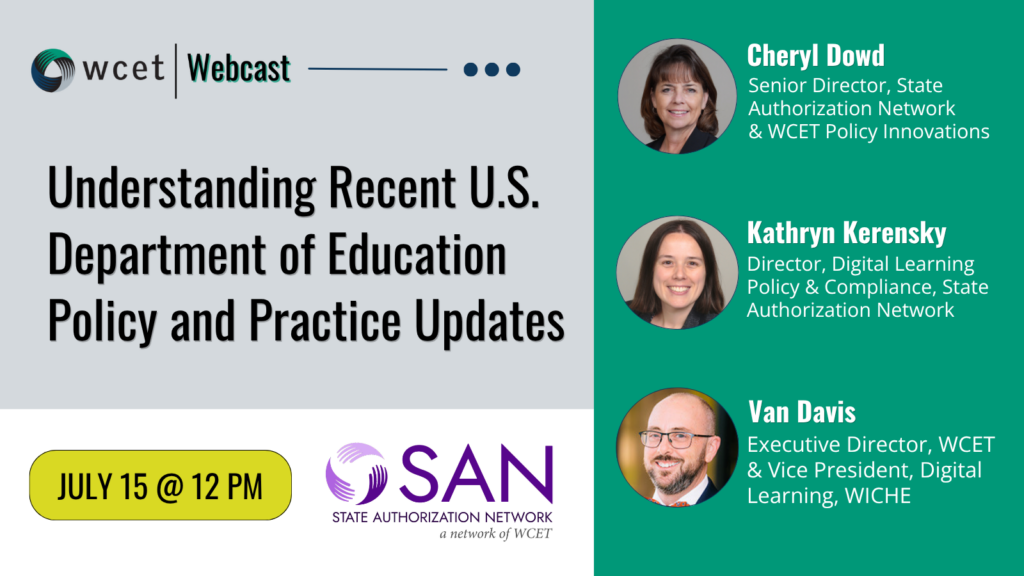
We encourage you to visit the WCET & SAN Policy Tracker for continued policy updates. Additionally, we encourage you to join us for a free webcast at 12 p.m. MT, July 15, 2026: Understanding Recent Federal Department of Education Policy and Practice Updates. SAVE YOUR SPOT.