Writing the Next Chapter: Distance Learning in the American Higher Ed Story
Published by: WCET | 8/6/2026
Tags: Distance Education, Managing Digital Learning, Technology
Published by: WCET | 8/6/2026
Tags: Distance Education, Managing Digital Learning, Technology
By Van L. Davis, Ph.D.
As America marks its semiquincentennial, it’s leading me to reflect on its 1976 bicentennial. One of my enduring childhood memories is of the Freedom Train that traveled around the United States, carrying various historical documents, including George Washington’s personal copy of the Constitution, a replica of the Liberty Bell, and my personal favorite, a prototype of the lunar rover.
Those symbols represented a shared belief that America’s future would be shaped by knowledge, discovery, and opportunity. Today, though, recognition of higher education and its role in advancing those qualities seems to be absent (or worse, maligned).
The first colleges in colonial America were private, religiously affiliated institutions. In 1636, Harvard University was founded, followed by the College of William and Mary in 1693 and Yale in 1701. It’s important to realize that the college-going population during the colonial period was minuscule, probably a scant less than 1% of the total population. Given the elite nature of these institutions, college life wasn’t originally about opportunity so much as “an insurance policy guaranteeing that these favored young men would acquire not only literacy but also a sense of leadership and service by about their twentieth birthday” (John R. Thelin, A History of American Higher Education).
By the period after the American Revolution, the small but growing number of institutions were strengthening their focus on preparing students for public service. As the charter for Brown University put it, “Institutions for liberal Education are highly beneficial to Society, by forming the rising Generation to Virtue, Knowledge and useful literature and thus preserving the Community a Succession of Men duly qualified for discharging the Office of Life with usefulness and reputation.”
This role of higher education for the public good was cemented in the 19th century with the passage of the Morrill Acts, first in 1862 and subsequently in 1890. Each of these acts provided states with public land for the purpose of endowing at least one college in each state focused on agriculture and the mechanical arts. The public land-grant colleges and universities significantly extended educational opportunities and access for American students, including Black Americans, through the creation of Historically Black Colleges and Universities with the second Morrill Act.
But it was really in the 20th century when educational access expanded. Between World War I and World War II, enrollment in colleges and universities rose from 250,000 to 1.3 million learners. After 1944’s passage of the Servicemen’s Readjustment Act, enrollment exploded, with an additional 2.25 million former service members going to college. In fact, expansion of higher education in the 20th century was so significant that the period between 1945 and 1970 is oftentimes considered to be a golden age of higher education, and according to Thelin, a period of “prosperity, prestige, and popularity.”
Higher education in the 20th century was more than just increasing access and educational opportunities for students. It was also seen as a critical component in American political life. In 1947, President Harry S. Truman created the Commission on Higher Education for Democracy which made several recommendations, including:
The Commission’s report underscored the importance of higher education in America’s political and civic life. As the report explained, “Education is indispensable to the maintenance and growth of freedom of thought, faith, enterprise, and association.” It further posited, “American colleges and universities must envision a much larger role for higher education in national life. They can no longer consider themselves merely the instrument for producing an intellectual elite. They must become the means by which every citizen, youth and adult, is enabled and encouraged to carry his education, formal and informal, as far as his native capacities permit.” In fact, the commission concluded its report by saying, “Universal education is indispensable to the full and living realization of the democratic ideal.”
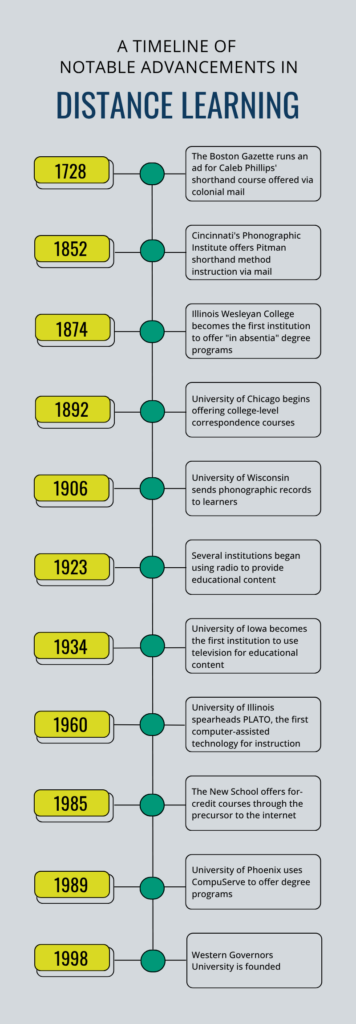
Fast forward to today, firmly mid-21st century: How does distance education fit into this timeline of American higher education? It expands access to those who might otherwise not be within reach, whether constrained by time, distance, finances, or a brick-and-mortar campus.
While Thelin describes online education as “one of the transformational innovations in American higher education,” the first instance of distance education was a 1728 Boston Gazette advertisement for Caleb Phillips’ shorthand course via the colonial mail. In it, the advertisement promises, “persons in the country desirous to learn this and may, by having the several lessons sent weekly to them, be as perfectly instructed as those that live in Boston.”
From colonial colleges preparing civic leaders, to the land-grant movement, the GI Bill, community colleges, and today’s digital learning innovations, each generation has expanded who can learn, how they learn, and what opportunities education makes possible. Higher education’s evolution into digital learning is not a departure from that; it is the next chapter in a long, continually evolving story.
If you are looking for a community of dedicated digital learning professionals and your institution isn’t already a WCET member, consider joining WCET today. Member or not, we invite you to attend WCET 2026, Oct. 14-16, in Minneapolis, where we’ll explore the latest advancements in digital learning.
After all, as my fellow Texan, President Lyndon B. Johnson, said in his 1965 Special Message to Congress, “Higher education is no longer a luxury, but a necessity.”
At WCET, we believe in transparency regarding our use of artificial intelligence. AI was used to assist in researching this blog post.