From Boot Camp to Quantum Careers: Central New Mexico Community College Builds a Workforce for an Emerging Industry
Published by: WCET | 9/22/2026
Published by: WCET | 9/22/2026
By Betsy Piland
What do a birth doula, vet tech, jeweler, firefighter, and food truck owner have in common?
They’re all students preparing for careers in quantum technology through a new program at Central New Mexico Community College (CNM), a WCET member institution. Through CNM Ingenuity, the nonprofit workforce development arm of the college, learners can enroll in an intensive Quantum Technician Bootcamp designed to prepare them for hands-on jobs in an emerging industry—without requiring a traditional degree program (unless they choose that path).
“These programs are built for people trying to upskill or transfer from one career to a completely different one—people who don’t have two years to invest,” said Deanna Sandoval, Senior Program Manager of CNM Ingenuity. That approach is particularly important in a field like quantum tech, which can sound intimidating. CNM’s Quantum Bootcamp offers another way for people to become technicians who can work with, maintain, and troubleshoot the specialized equipment that makes quantum research and development possible.
And, according to Sandoval, employers are already looking for those skills.
CNM Ingenuity’s Quantum Technician Bootcamp is modeled after its established Deep Dive programs, which use short, intensive training to prepare learners for technology careers.
The program runs for 10 weeks, Monday through Friday, from 8 a.m. to 5 p.m., and unlike a program centered on computing or theory, the program emphasizes the hands-on, manufacturing side of quantum technology.
Learners work in CNM’s FUSE Makerspace, a fabrication lab that includes wood and metal shops, large-format CNC machines, laser cutters, 3D printers, screen printing, wide-format digital printing, and a comprehensive digital design suite. They learn some quantum theory and software, but much of their time is spent developing the practical skills required to work with laboratory equipment.
If a piece of equipment goes down, for example, learners can 3D-model it and troubleshoot the problem. They learn to read manuals, build components, and become comfortable working around the kinds of equipment they will encounter on the job.
That curriculum isn’t being developed in isolation, nor is it established and allowed to remain static. “We visit companies, spend time on their manufacturing floors and in their labs. We talk to the folks doing the work today and to the leadership about the work of the future. Between semesters, we go back to companies, validate what we learned before and look for emerging trends,” explained Brian Rashap, Ph.D., a quantum and Internet of Things educator at CNM.
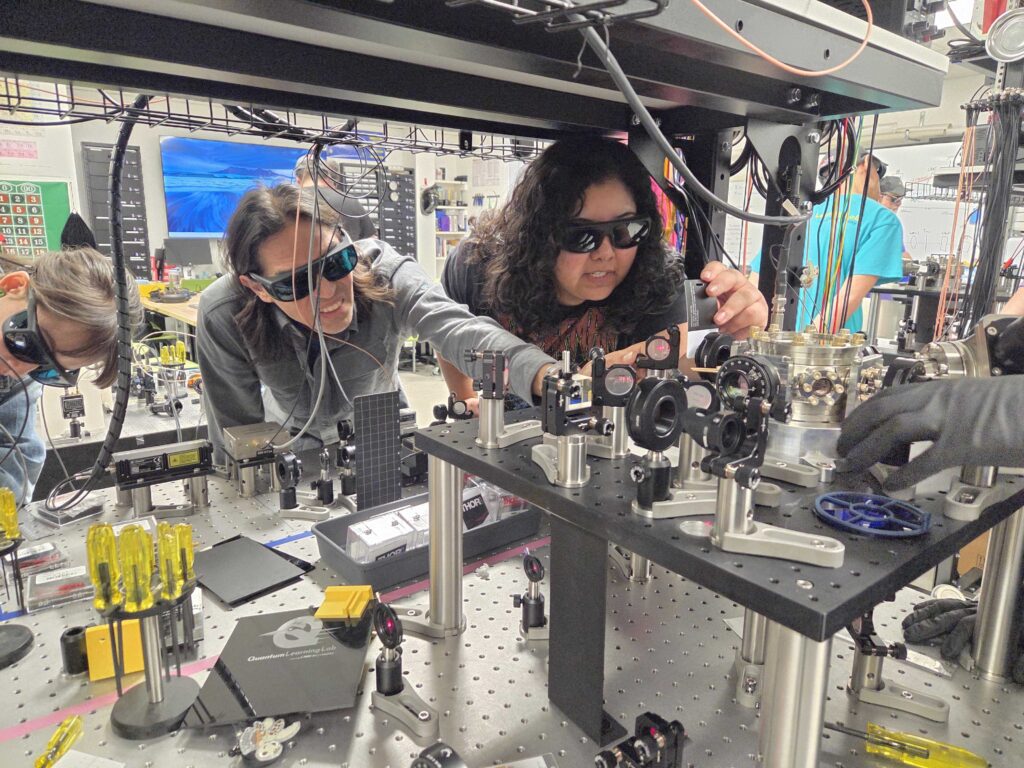
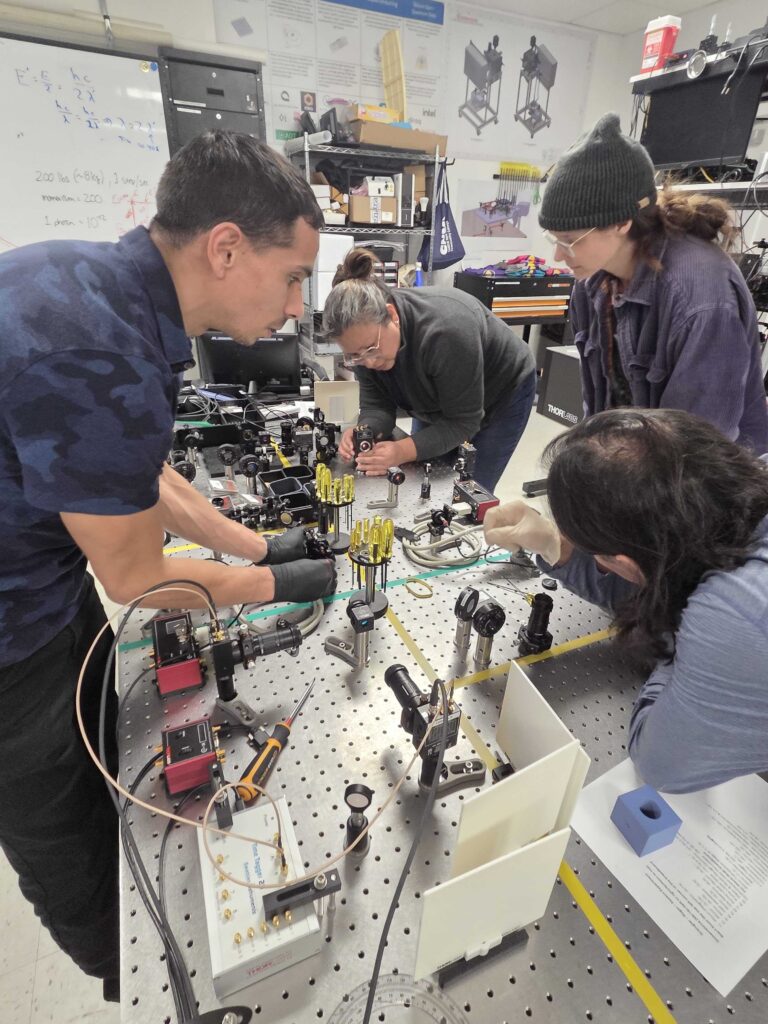
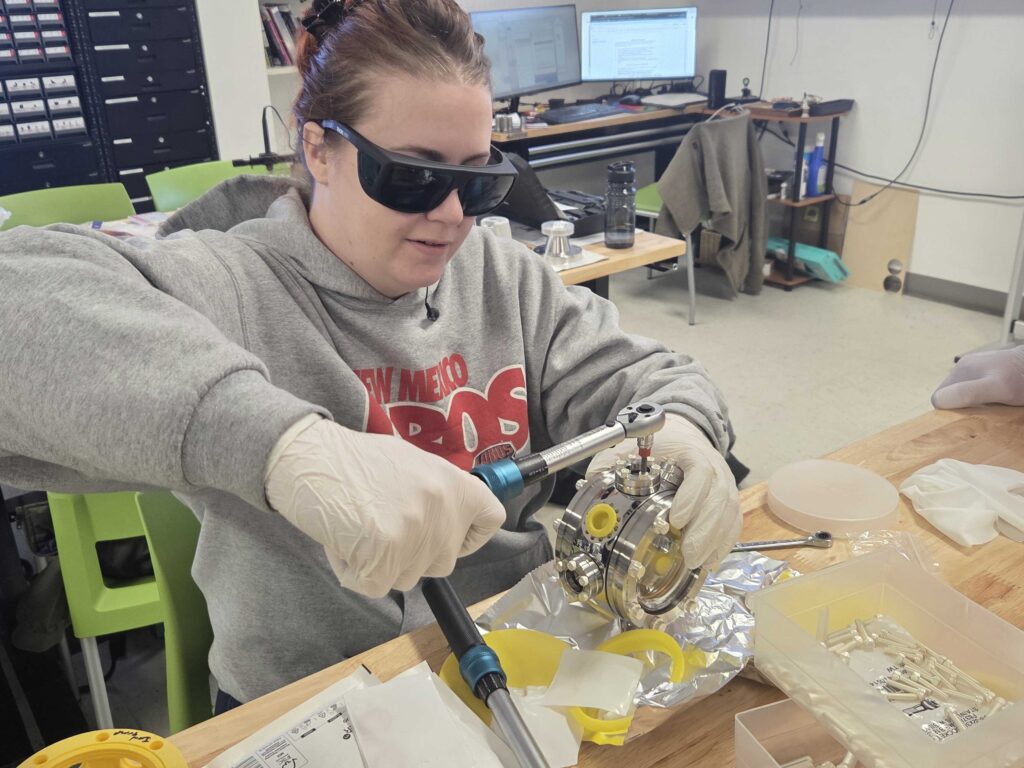
The program itself grew out of a larger push to develop the region’s quantum economy. Sandoval said CNM Ingenuity has worked with Sandia National Laboratories, while state and federal grants have helped the organization build its lab and develop workforce training. The effort comes as New Mexico works to establish itself as a center for the emerging quantum industry.
For Sandoval, preparing learners begins long before the first day of class.
She often spends months getting to know potential students, hosting them at open houses, and giving them opportunities to meet instructors and ask questions. CNM Ingenuity’s personal touch aligns with the program’s philosophy around accessibility. No math or science background is required; students are taught all the math and science they’ll need for the duration of their technician careers.
“I want students to be prepared and excited for the next steps toward their career. I always look forward to meeting them and addressing their questions and concerns,“ said Sandoval. That matters because the program is intense, and a quantum technician’s work might not look like what someone initially imagines. “Some people realize, ‘Oh, this is on my feet, this is opening a manual, this is like being a mechanic,’” said Sandoval. “It’s really important that we prepare them for the full 10 weeks, that they’re excited to be there and know exactly what they’ll be doing. There’s a relationship built before they even get into the class.”
Cohorts are deliberately small—just 12 learners at a time, with two cohorts per year. The program brings together instructors with different areas of expertise, including engineering, technician experience, and quantum science.
Technical training is only part of the experience. Employers visit the lab, give presentations on their company, host Q&A sessions; students are also given the opportunity to demonstrate what they’re working on. “It’s less of a presentation and more of a dialogue,” said Rashap. “Both groups are learning from each other.”
“Exactly,” said Sandoval. “Employers can hear how students approached technical projects and ask questions about their skills and challenges. It’s kind of a pre-interview in a lot of ways.” And sometimes, that pre-interview turns into something much more concrete.
There’s a bell in the Quantum Technician Bootcamp classroom that learners ring when they land a job.
“We’ve had people ring it on graduation day,” Sandoval said. “Last time, two people got job offers on graduation day.”
Employers interact with learners throughout the 10-week program, and instructors can help identify which graduates might be particularly well suited for certain opportunities. At the time of the interview, Sandoval estimated the program had about a 90% success rate, with all but two learners either finding jobs or continuing their education toward a degree.
The jobs can also offer a significant economic step up. Sandoval said the job offers graduates had reported salaries in the $75,000 to $80,000 range. Beyond compensation, graduates have told her that their experience with real equipment gives them confidence once they enter a workplace.
“We’ve had learners come back and say they were up against a bunch of other interns, and they were literally the only ones in the room who knew how to set up the equipment and understood the tables,” Sandoval said. For a program designed around workforce readiness, that familiarity is a meaningful outcome: learners aren’t encountering the tools of their new profession for the first time after they’ve been hired.
Perhaps one of the most notable aspects of the boot camp is who is pursuing this career path. “It’s anybody and everybody,” Sandoval said. The youngest learner so far was around 20, and the oldest was in their 60s. Participants have included people with advanced degrees alongside people coming from jobs that have little obvious connection to quantum technology. Sandoval recalled learners who had worked as birth doulas, veterinary technicians, jewelers, firefighters, teachers, and food truck owners. One of the youngest participants had been stocking shelves before entering the program. Sandoval said he was the first person in his cohort to get a job.
That range of backgrounds underscores an important part of CNM Ingenuity’s model: workforce development in an emerging technology doesn’t necessarily have to begin by asking whether someone already looks like a quantum professional. It can begin by asking whether they want to become one.
Not every learner who discovers an interest in quantum wants to stop after 10 weeks.
That’s where the connection between CNM Ingenuity and the college’s credit-bearing programs becomes particularly valuable. Hye Clark, Associate Dean for CNM’s School of Business, Hospitality, and Technology, works on the credit side of the college, where a 25-credit-hour Quantum Computing Technician certificate is launching this fall. The program builds on the boot camp by providing structured, progressive coursework in programming, mathematics, optics, photonics, quantum algorithms, and quantum hardware. Together, the boot camp and certificate create a flexible pathway from introductory workforce training to technician-level preparation and continued education.
CNM is also working to provide Credit for Prior Learning opportunities for boot camp graduates. Rather than starting over when they decide they want to continue their education, learners may be able to receive credit for skills they have already developed and then complete additional coursework toward the Quantum Computing Technician certificate.
Sandoval sees that pathway emerge naturally during the boot camp. Learners who become especially interested in quantum computing or want to dig deeper into the science may discover that their next step is a certificate, degree, or even an engineering career.
Demand for the boot camp is already greater than its current capacity. Sandoval said more than 200 people had reached out about the program over roughly a year and a half, but CNM Ingenuity isn’t interested in growing the program simply for growth’s sake.
“We want each of them to get a job; we want to deliver very high-quality technicians to these companies,” Sandoval said. “We’ll build the technician program as the demand grows, because it’s about balance. We don’t want to oversaturate and leave technicians with nowhere to go.”
That philosophy captures what makes the program noteworthy as a workforce development model. CNM isn’t simply creating a quantum curriculum and hoping employers eventually need it. The institution is watching where industry is moving, talking with employers, adapting training based on their feedback, and creating pathways that can carry learners from an intensive boot camp into employment or further education.
That adaptation is especially important in a field changing as rapidly as quantum technology. After employers repeatedly asked about fiber optics, for example, the boot camp began looking at how to incorporate it.
“It’s a constantly evolving, rolling beast—that’s the nature of a Deep Dive boot camp, and of quantum,” Sandoval said. “It changes so quickly you have no choice but to evolve with it.”
For CNM, evolving with it means keeping one eye on where the technology is going and the other firmly on where the jobs are. And for learners who may never have imagined themselves working in technology, it means an emerging industry suddenly has an accessible entry point.