Adopting AI Together: How the University of Texas at San Antonio Built a 150-Member Peer Learning Network
Published by: WCET | 11/12/2026
Published by: WCET | 11/12/2026
by Betsy Piland
When ChatGPT upended higher education, many institutions scrambled to respond with restrictions and policies. The University of Texas at San Antonio took a different path by inviting faculty and students to learn and make decisions about AI adoption together.
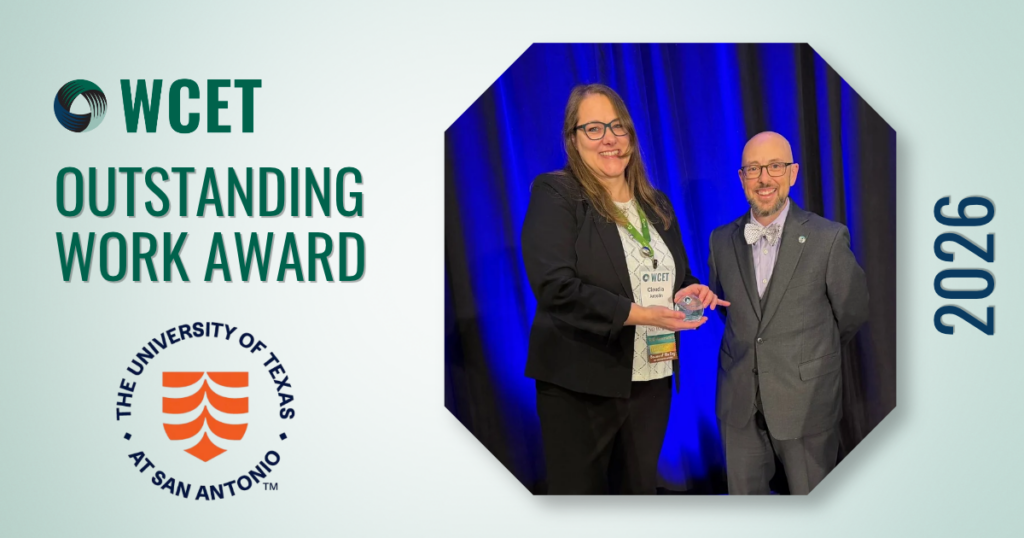
That decision is what evolved into the Generative AI Peer Learning Network, which earned UT San Antonio’s Division of Academic Innovation a 2026 WCET Outstanding Work (WOW) Award, presented to the university at the 2026 WCET Annual Conference in Minneapolis.
The network began as a small grassroots effort but quickly grew into a 150-member community spanning every college and department at UT San Antonio. The group makeup was intentionally broad: faculty and instructional designers, librarians and doctoral students, and staff from IT, student success, career services, institutional research, and more—all coordinated through the Division of Academic Innovation.
Melissa Vito, Vice Provost of Academic Innovation at UT San Antonio explains, “Keeping our community engaged and sustaining momentum is essential to turning innovation into meaningful transformations and lasting improvements in the learning experience.”
UT San Antonio approached the topic of AI with curiosity instead of immediate judgement. In the early months, faculty and outside speakers shared what they had learned from their first experiments with generative AI in the classroom. From there, members created a self-paced Teaching and Learning with AI course, letting faculty in any area build a new digital fluency at their own pace.
“When faculty tell us these are the meetings they look forward to, we know we’re creating a space where curiosity drives conversation, challenges spark new ideas, and the student experience remains at the center, says Claudia Arcolin, UT San Antonio’s Assistant Vice Provost for Teaching, Learning, and Strategic Initiatives.
Today, partners from student success, IT, institutional research, and the library work alongside faculty to support responsible AI adoption at scale. What began as a small group comparing notes has become part of how the university operates.
Faculty redesigned courses around critical thinking, creativity, and real-world application, while including assessments that AI can’t complete on its own, with two examples standing out.
First, in a general education astronomy course serving more than 130 students, faculty added podcasts, NotebookLM-generated infographics, and a course chatbot. More than 70% of students reported a more engaging experience and a better understanding of the material. And in a large technical writing course (more than 17 sections and over 600 students each semester), faculty piloted a new microcredential, Writing in the AI Era. Students said it helped them think more critically about AI and its role in writing and learning.
Perhaps the biggest change is how UT San Antonio talks about AI. It’s seen as an invitation to teach more intentionally, build more meaningful assessments, and prepare students for a world these tools have already shaped.
Regardless of the course type or topic, AI-supported tutoring and feedback gave students more personalized, responsive ways to learn.
With AI firmly entrenched in higher education, the questions haven’t stopped coming. At the University of Texas at San Antonio, neither has the conversation.