Beyond Borders: Understanding Global Compliance in Distance Education
Published by: WCET | 11/16/2026
Tags: Compliance, Distance Education, Managing Digital Learning, State Authorization
Published by: WCET | 11/16/2026
Tags: Compliance, Distance Education, Managing Digital Learning, State Authorization
by Kathryn Kerensky
A student lets your institution know that they have relocated to another country but want to continue their online program. Or a faculty member asks for permission to teach remotely while living abroad. Perhaps a service member is stationed overseas, or a student wants to complete an internship or clinical experience in another country.
What would your institution do?
These situations may seem like isolated requests, but each can raise questions about what an institution is permitted or required to do when offering activities outside the United States. And with no single global framework to guide decision-making, understanding what applies can feel complicated.
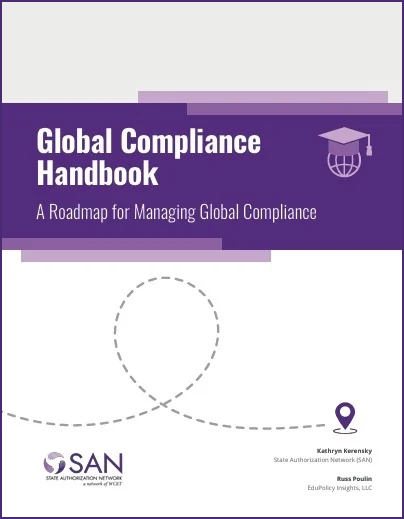
Your colleagues across the SAN community are likely tackling many of the same challenges, and sharing those experiences can mean you don’t have to navigate these questions alone. Through the SAN Global Compliance Handbook, related resources, and opportunities for networking and discussion, the State Authorization Network helps institutions build their understanding, share experiences, and develop practical approaches to global compliance.
Getting started means understanding when global compliance may come into play, knowing what questions to ask, and having a way to work through them when they arise. SAN’s resources and community can help institutions take those steps.
Here are four questions to help institutions begin thinking about global compliance in distance education.
Yes. An institution does not need an international campus, physical location, or active recruitment strategy for its activities to raise global compliance questions.
For example, an institution may enroll a student who lives in another country, even if that student originally enrolled while living in the United States and later relocated. Students may also complete internships, clinical experiences, field placements, or other hands-on learning activities abroad. Military-connected students offer another example. A service member may be stationed overseas while continuing an online program, or a military-connected student may relocate abroad. Each situation can raise questions about what the institution is permitted or required to do in that country.
That is one reason knowing where students are located matters. Institutions are already familiar with the importance of student location for state authorization and professional licensure requirements in the United States. The same awareness can help identify when a student’s location outside the United States may introduce additional questions.
Yes. Even a single student, employee, or educational activity in another country can raise questions worth reviewing.
Not every institution is actively recruiting internationally or enrolling large numbers of students abroad. Some may only encounter an international question once in a while: a student relocates while completing an online program, an employee requests permission to work remotely from another country, or a student asks to complete an internship or clinical experience abroad.
In these situations, it can be tempting to treat each inquiry as a one-time decision. But having a consistent way to review these requests is important. A basic process can help institutions determine who should be involved, what information needs to be gathered, which areas of compliance should be considered, and when additional expertise may be needed. It also gives institutions a way to document their research and decisions. If a similar request comes up later, they have a starting point rather than having to begin again.
There are practical reasons to get these decisions right. Depending on the country and the activity, failing to meet applicable requirements can lead to restrictions on educational activities; financial consequences such as fines, penalties, or refunds; challenges to the recognition of educational activities or credentials; and legal, regulatory, or reputational harm to the institution.
These consequences can affect students, too. If an institution has to pause, change, or discontinue an activity because it has not met local requirements, students may face unexpected disruptions to their education, clinical placements, access to services, or progress toward a credential or professional pathway. In some cases, the consequences may extend beyond the immediate disruption and affect how students’ educational experiences or credentials are recognized.
A thoughtful review process helps institutions:
The goal is to have a reasonable, repeatable way to evaluate the situations that come up and learn from them as the institution’s activities evolve.
Once an institution recognizes that an international activity may raise compliance questions, the next step is figuring out what to look at. This can feel like a lot, particularly when the institution is unfamiliar with the country’s laws or regulatory systems.
Global compliance is broader than getting permission to offer an educational program or activity in another country. Depending on the country and the institution’s activities, requirements may involve institutional authorization or approval, consumer protection, program approval, privacy and data protection, employment, taxation, or other local obligations.
The questions can look quite different depending on the situation. Enrolling an online student who lives abroad may raise different considerations from arranging an international clinical experience or allowing an employee to work remotely from another country. Even within the same country, different activities can lead to different requirements.
Institutions do not need to become experts in every area or country before they can begin, but they do need a way to identify the activities involved, determine which areas may require further research, and involve the appropriate people in reviewing them. This may mean coordinating across departments such as compliance, academic affairs, human resources, legal counsel (including outside counsel when appropriate), or other institutional offices.
Looking at the full range of institutional activities and having a process for asking the right questions can help institutions determine where to focus their attention and what additional guidance they may need.
Wondering where and how to begin? The SAN Global Compliance Handbook provides a framework to help institutions understand the different parts of global compliance and develop an approach that fits their activities and resources.
The Handbook is not a country-by-country legal reference, nor is it a checklist that every institution needs to complete in exactly the same way. Instead, it offers a series of checkpoints to help institutions look at their current practices, identify areas that may need attention, and consider how to build or strengthen their processes.
Institutions can use the Handbook in different ways depending on where they are starting. The accompanying Self-Assessment and Maturity Overview can help institutions consider their current level of preparation and identify next steps. Other SAN resources—including country-specific resources for Canada and Mexico, the International Ministries Chart, and the Global Compliance Research Task Checklist (Appendix 1 in the handbook)—can give a starting point for country research and help institutions explore particular questions and organize their research.
And the resources are not the only way SAN supports this work. SAN’s interactive networking and discussion opportunities facilitate learning how other institutions approach common questions, share experiences, and learn from colleagues who may be working through similar situations. Some resources and opportunities are only available to the SAN community through enrollment in SAN.
Whether your institution is responding to its first international inquiry or refining an established process, these resources and connections can help make the work more manageable.
Global compliance can feel like a big undertaking, particularly for institutions that have not traditionally focused on international activity. But getting started does not require a comprehensive program or expertise in every country’s requirements. It starts with recognizing when international obligations may come into play, knowing what questions to ask, and having a consistent way to work through them.
A thoughtful approach can help institutions make informed decisions, protect students, maintain continuity of education and services, and manage institutional risk as circumstances change.
SAN will continue developing resources and opportunities for institutions to learn from one another, share practical approaches, and build their understanding of global compliance. We encourage institutions to explore the Global Compliance Handbook and related resources, connect with the SAN community, and take the next step toward an approach that works for them.